
Demo account UK: how to practise before your first CFD or spread bet
 Systemly Team
£10,000. That is the pre-set balance IG gives a new UK demo account, and CMC Markets offers the same. It sounds generous. For someone planning to fund a real account with £2,000, it is the first thing a demo gets wrong, because every position you practise is sized five times too big.
So here is the short version. Use a UK demo account to learn the platform you will actually trade on. Then practise the trade itself, sizing, stops and a daily limit, at your real account size, with costs switched on.
Quick answer: A UK demo account from an FCA-authorised broker is the best way to learn that broker's platform before your first CFD or spread bet. It is a weak way to learn risk, because big UK demos start at £10,000, and IG itself discloses that its demo skips slippage, overnight interest and margin close-outs. Systemly is the better place to practise the plan and the sizing at your real balance, with real spreads and costs and an Academy that explains each step. Use both, then decide whether to go live at all.
Systemly publishes this guide. We have tried to be fair, and every outside fact below is sourced and checked 18 October 2026.
Why UK traders say "demo account"
UK search behaviour splits two ways. On the worldwide maps, the UK scores 19 for "paper trading" and 34 for "trading simulator". Under "demo account", the UK's related searches are mostly broker and platform names: "forex demo account", "mt5 demo account", "trading 212 demo account", "ftmo demo account", "mt4 demo account" and others, with AvaTrade rising as a breakout (Google Trends, 12 months to October 2026). These are relative scores, not volumes.
In other words, a UK reader searching "demo account" has usually already picked a broker, or is about to. This guide is for the step before that decision.
What the loss figures say
The FCA's own analysis, published in December 2016, found that 82% of a representative sample of CFD clients lost money. More recently the FCA has said that about 80% of customers lose money on CFDs.
Firms must now show their own figure. IG's demo sign-up page carried the warning "70% of retail investor accounts lose money when trading spread bets and CFDs with this provider" when we checked. A Pound Sterling Live report of 27 March 2026 put the figure at about 68% for IG and CMC Markets, 76% for Plus500 and over 81% for Swissquote. These numbers change every quarter.
Who is joining matters too. When the FCA surveyed self-directed investors in 2021, more than 4 in 10 did not count losing some money as a risk of investing, yet 59% said a significant loss would fundamentally affect their lifestyle. In 2024 the FCA reported that 62% of 18 to 29 year olds follow social media influencers, and 74% of those followers trust their advice.
Put those together and you get a familiar picture: a young trader, a confident influencer, and an account that will probably lose. A demo is meant to break that pattern. Whether it does depends on how it is set up, which is where the fifth row of the table below comes in.
The mistake: treating the demo as a dress rehearsal
Most people open a UK demo, accept the £10,000 and start placing trades the way they would like to trade. The demo feels like a dress rehearsal for live.
The consequence is that the rehearsal skips the scenes that hurt, and the brokers say so themselves. In IG's list of demo differences, slippage, interest and dividend adjustments and out-of-hours moves are all missing. A demo order may be refused for lack of funds, IG says, but "never for size or price", and a demo position stays open even when your funds no longer cover the margin. IG calls the list "by no means an exhaustive list". Pepperstone warns that its demos "may not reflect live trading conditions".
To use an analogy, it is like a fire drill where everyone knows the date and the stairs are clear. You learn the route out. You do not learn what smoke does to your judgement.
What a UK demo usually skips, and what Systemly's paper account does
- Starting balance: Live FCA-regulated account: Your deposit; IG UK demo (from IG's own list): £10,000 pre-set; Systemly paper account: Your choice, 100 to 1,000,000 in GBP, USD or EUR
- Slippage on stops: Live FCA-regulated account: Can happen; IG UK demo (from IG's own list): Not applied; Systemly paper account: Applied as a labelled assumption
- Overnight funding: Live FCA-regulated account: Charged; IG UK demo (from IG's own list): No interest adjustments; Systemly paper account: Assumed swap, labelled, tripled on Wednesday
- Orders refused for size: Live FCA-regulated account: Can be; IG UK demo (from IG's own list): "Never for size or price"; Systemly paper account: Plans below the minimum lot are refused
- Margin close-out at 50%: Live FCA-regulated account: Required by FCA rules; IG UK demo (from IG's own list): Positions not closed for margin; Systemly paper account: Margin checked at retail leverage; we make no close-out claim
- Spread bet stakes in £ per point: Live FCA-regulated account: Yes, at spread betting firms; IG UK demo (from IG's own list): Yes; Systemly paper account: No, sized in lots
- The platform you will really use: Live FCA-regulated account: Yes; IG UK demo (from IG's own list): Yes, the same platform; Systemly paper account: No, Systemly is not a broker platform
- How often results update: Live FCA-regulated account: Tick by tick; IG UK demo (from IG's own list): Live prices; Systemly paper account: Results checked every 15 minutes
Read the fifth row twice. The FCA requires firms to close retail positions when funds fall to 50% of the margin needed, and a demo that never closes you out cannot teach that rule. Systemly checks margin at retail leverage, but we do not claim it simulates a close-out either. The best a beginner can do is size so small that margin is never the question.
Systemly loses or draws four rows: margin close-out, spread bet stakes, the real platform and update speed. That is why we say use both.
How to size your first trade: lots and pounds per point
Example, not a signal.
Say your real account will be £2,000. Set a paper balance of £2,000 in pounds, not the 10,000 default preset.
As a CFD, in lots
- Risk per trade at 1% is £20. At an illustrative 1.30 dollars to the pound, that is $26.
- The plan is GBP/USD with a 30-pip stop.
- On GBP/USD, one standard lot moves $10 per pip, so 0.01 lot moves $0.10. Over 30 pips, 0.01 lot risks $3.
- Lots = $26 ÷ $3 × 0.01 = 0.0867. Round down to 0.08 lots.
- Real risk = 0.08 × 30 × $10 = $24, which is £18.46 at 1.30, or 0.92% of the account.
Margin at the FCA's 30:1 cap on a major pair is a separate number. 0.08 lots of GBP/USD is £8,000 of exposure, so the margin needed is £8,000 ÷ 30 = £266.67, which is 13.3% of the account. Margin is a deposit, not a cost, but it tells you how much of the account a single trade ties up. Our forex margin calculator guide explains the formula.
As a spread bet, in pounds per point
Many UK spread betting firms quote GBP/USD so that one point is one pip. Check your provider.
- Risk at 1% is £20.
- Stake = £20 ÷ 30 points = £0.667 per point. Round down to £0.66.
- Real risk = 30 × £0.66 = £19.80, which is 0.99%.
Now the uncomfortable case. If your provider's minimum stake on that market were £1 a point, the same 30-point stop would risk £30, which is 1.5% of the account. The fix is not to round up and hope. It is a tighter stop that still makes sense, a different trade, or no trade. Systemly applies the same discipline in lots: a plan below the minimum lot is refused rather than resized.
On the £10,000 demo, the 1% rule would have risked £100 on this trade. That is five times the £20 budget of the real £2,000 account. Check any trade in the free Risk Doctor position size check, and see our pip calculator guide for pip values on other pairs.
Spread betting and CFDs in two paragraphs
A CFD is a contract to exchange the difference in price between opening and closing a position. A spread bet does a similar job, but you stake an amount per point of movement. For most UK individuals, spread betting profits are generally free of Capital Gains Tax and Stamp Duty, because HMRC treats most spread bets as gambling. CFD profits are generally subject to CGT, and CFD losses can be offset. Tax treatment depends on individual circumstances and can change, so check HMRC's guidance or ask an adviser. We give no tax advice.
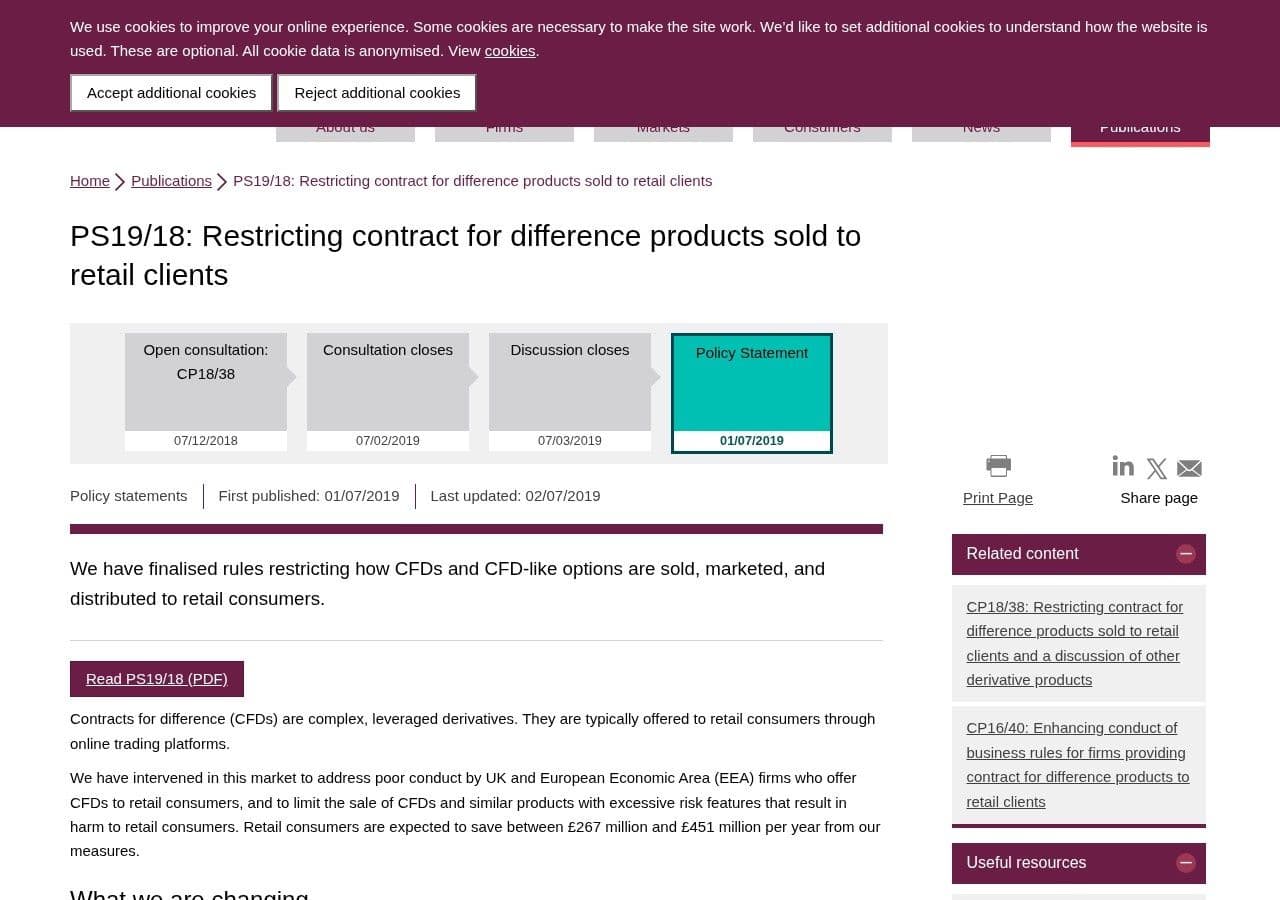
Both products carry the same FCA protections for retail clients: leverage caps of 30:1 on major pairs and 20:1 on gold and major indices, a 50% margin close-out, negative balance protection, and a ban on inducements to trade. A demo account practises the product mechanics. It does not change the odds.
Demos as funnels: what researchers found
Demo apps also talk to you. Researchers writing in Behavioural Public Policy in 2025 signed up to the 14 most-downloaded UK CFD apps in demo mode and counted what arrived. In week one that was 77 emails and 60 push notifications, and 96.1% of the emails were engagement marketing. Almost a third of the risk warnings (31.6%) fell short of FCA standards, and the educational material tended to blame losses on discipline rather than odds. The study did not measure how many demo users went on to trade live.
That does not mean any named broker is trying to mislead you. Several, including IG and Pepperstone, publish clear lists of how demos differ from live. It does mean a demo is a product with a commercial purpose. Notice the nudges, and decide in your own time.
Expiry is the other quiet nudge. A demo that closes after a month without trades, as CMC's MT4 demo does, or after two months of inactivity, as Pepperstone's UK MT4 and MT5 demos do, pushes you to trade often rather than slowly and well. Our UK demo accounts comparison sets the main brokers side by side.
A routine for your first four weeks, in UK time
The UK goes back to GMT on 25 October 2026. The London open stays at 08:00 UK time, and US data usually lands at 13:30. The week of 25 to 31 October is the exception: the US has not changed its clocks yet, so US data arrives at 12:30 and the Fed decision on Wednesday 28 October lands at 18:00 UK time.
- Week one: the platform. If you already have an FCA-authorised broker in mind, use its demo to learn the order ticket, how to set a stop and how to close a position. Do not judge anything by profit.
- Week two: the plan. In Systemly, take "Your first trade", a free Foundations course, then generate plans on GBP/USD, EUR/USD or gold. Read "Why this trade" on each. Place two or three as paper trades at £2,000, or whatever your real size is.
- Week three: the rules. Take "The checklist" and "Building discipline". Set the Limits tab: 1% risk per trade and a 3% daily loss limit are the defaults in the "Keep it simple" preset, which is an untested starting point. The daily limit resets at 21:00 UTC, which is 21:00 UK time in winter.
- Week four: review. Take "Journal and review". Look at every closed trade on the trades dashboard and write one line on each: did I follow the plan, did I move the stop, would I take it again?
In weeks two to four, every paper trade starts the same way: Execute, then Paper, then a confirm dialog marked "Paper trade. No real money." You will hear about fills, targets, stops and expiry in the app or by browser notification rather than by email. Because results are checked every 15 minutes, a stop hit at 08:03 may show a little later, but it is still booked at the stop price. Three open paper trades on the free plan is plenty for this routine.
Why we think Systemly is the better place to practise the trade
Systemly (systemly.ai) is a UK-built forex and gold trade-planning app that turns live price data into a complete trade plan, with entry, stop, targets, position size and plain-English reasoning, and teaches the terms in a built-in academy of 32 courses.
Most broker demos give you virtual money and a chart to fill yourself. Systemly gives you a plan to practise, a school that explains why the plan looks the way it does, and paper rules that refuse to flatter you. A buy fills at the ask, stops trigger on the bid, a limit only fills if price trades through it, and a candle that touches both stop and target counts as the stop. The risk limits you set on paper become habits you can take to any future account.
It is not a broker, it is not FCA-authorised and it gives no personal recommendations. A real broker connection is not available yet. That is exactly why you also need a demo with the broker you choose.
Green flags and red flags in a UK demo
Green flags:
- The broker is on the FCA register under its exact legal name.
- It publishes a clear list of how its demo differs from live.
- You can set a balance close to your real deposit.
- Its risk warning shows a current percentage of losing accounts.
Red flags:
- A "demo" that asks for card details or a deposit first.
- A signal group or influencer who sends you a link to a specific demo.
- A competition that rewards the biggest paper return.
- Daily emails urging you to "go live" before you have closed ten trades.
When a demo or paper trading is not the answer
Sometimes the right answer is to stop. Seru, Shumway and Stoffman's research on investor records found that much apparent "learning" is really people working out that they lack skill and leaving. A month of practice that ends with "not for me" has cost you nothing.
Feelings are the gap no demo closes. When Holt and Laury raised the stakes in their experiments, people paid in real money grew much more cautious, while people choosing over hypothetical sums barely changed. Our guide to paper trading psychology covers how to make practice feel more real, and the paper trading journal guide covers what to record. If your aim is a prop challenge rather than a personal account, read practising a prop firm challenge on paper.
How we checked
We read the official demo and help pages of IG, CMC Markets and Pepperstone, the FCA's press releases and policy statement on CFDs, HMRC's manuals and broker summaries on tax, and the 2025 Behavioural Public Policy audit. Loss percentages come from the FCA, IG's own page and a March 2026 press report. Everything was checked on 18 October 2026. Broker terms, loss figures and tax rules change, so check them before you act.
FAQ
What is the best demo account in the UK?
The best UK demo account is the one offered by the FCA-authorised broker you are most likely to use, because it teaches that platform. IG and CMC Markets start demos at £10,000. For practising sizing and a full trade plan at your real balance, with real spreads and costs, Systemly's paper account is a strong companion to that demo.
Do UK demo accounts expire?
Some do. CMC says its Next Generation demo does not expire, but its MT4 demo lapses after 30 days with no trading. Pepperstone's UK page gives 60 days of inactivity for MT4 and MT5 and 90 days for cTrader and TradingView. On Systemly, a reset in Settings starts a new paper account and keeps the old history readable.
Is a demo account the same as real trading?
No. By IG's own account, its demo leaves out slippage, interest adjustments and out-of-hours moves, never refuses an order for size or price, and keeps positions open when margin runs short. Real money also brings fear and greed that no simulator reproduces. A demo teaches mechanics. It cannot tell you how you will behave when the money is yours.
Can you demo spread betting in the UK?
Yes. IG and other UK spread betting firms offer demos where you stake in pounds per point. That is the best way to learn a spread betting platform. Systemly's paper account sizes in lots rather than pounds per point, so use it for planning and sizing practice and a broker demo for the spread bet ticket itself.
How much should I put in a demo account?
Use the amount you would really deposit. If you plan to fund £2,000, set the demo or paper balance at £2,000. On a £10,000 demo, a 1% risk is £100, which is 5% of a £2,000 account. Systemly lets you set a custom paper balance from 100 to 1,000,000 in pounds, dollars or euros.
What percentage of UK CFD traders lose money?
The FCA found 82% of a representative sample of CFD clients lost money in its 2016 analysis, and has since said about 80% of customers lose. Brokers must publish their own figure. A March 2026 report put IG and CMC Markets at about 68%, Plus500 at 76% and Swissquote above 81%. The figures change quarterly.
Is Systemly a UK demo account?
No. Systemly is not a broker and does not hold client money. It is a UK-built trade-planning app with a paper account that practises its plans at your real size, with real spreads and costs. It is not FCA-authorised and gives no personal recommendations. Use it alongside a demo from an FCA-authorised broker, not instead of checking that broker.
Practise the plan, then the platform
If your first CFD or spread bet is weeks away, learn the risk before the platform. A free Systemly account lets you set a paper balance in pounds at your real size, and the free Foundations courses in the Systemly Academy cover orders, stops and risk per trade. If the first market you mean to spread bet is the FTSE or the Dax rather than a currency pair, practise on it: UK100 and GER40 are on Plus, with 4H and slower charts and Check my trade, while Starter keeps to forex and gold but opens the full Academy and the chart layers. Each paid plan has a 3-day free trial, so you can rehearse the market you actually intend to trade before choosing.
The community scans feed shows real plans, and the Systemly home page explains the rest. For the bigger picture, our guides to the best way to learn forex in the UK, UK broker app charts and TikTok forex influencers are a good next read.
Sources
- IG: how to open a demo spread betting or CFD account
- IG: how a demo account differs from a live account
- IG: demo account sign-up page and risk warning
- CMC Markets: forex demo account
- CMC Markets: demo account FAQ
- Pepperstone UK: demo accounts
- FCA: proposals for stricter rules on CFDs, 82% figure (2016)
- FCA: finfluencers charged, about 80% of CFD customers lose
- FCA: PS19/18 restricting CFD products for retail clients
- FCA: younger investors taking big financial risks (2021)
- FCA: crackdown on illegal finfluencers (2024)
- Pound Sterling Live: most CFD accounts lost money at major UK brokers
- HMRC Business Income Manual BIM56900
- IG: spread betting vs CFDs
- CMC Markets: spread betting tax in the UK
- Andrade et al. (2025), audit of demo-mode CFD trading apps, Behavioural Public Policy
- GOV.UK: when do the clocks change
- Federal Reserve: FOMC calendar
- Seru, Shumway and Stoffman (2010), Learning by Trading
- Holt and Laury (2002), Risk Aversion and Incentive Effects (PDF)
- Google Trends, 12 months to October 2026 (our own pull, relative interest scores)
Trading forex and CFDs carries a high risk of losing money, and most retail accounts do. Paper trading uses no real money, and paper results do not predict live results. Systemly is an educational and trade-planning tool. It does not provide financial advice or personal recommendations, and it is not authorised by the FCA or licensed in the UAE or elsewhere to do so. Past outcomes do not predict future results.