
Is BabyPips worth it in 2026? BabyPips vs Systemly after the $29 price rise
 Systemly Team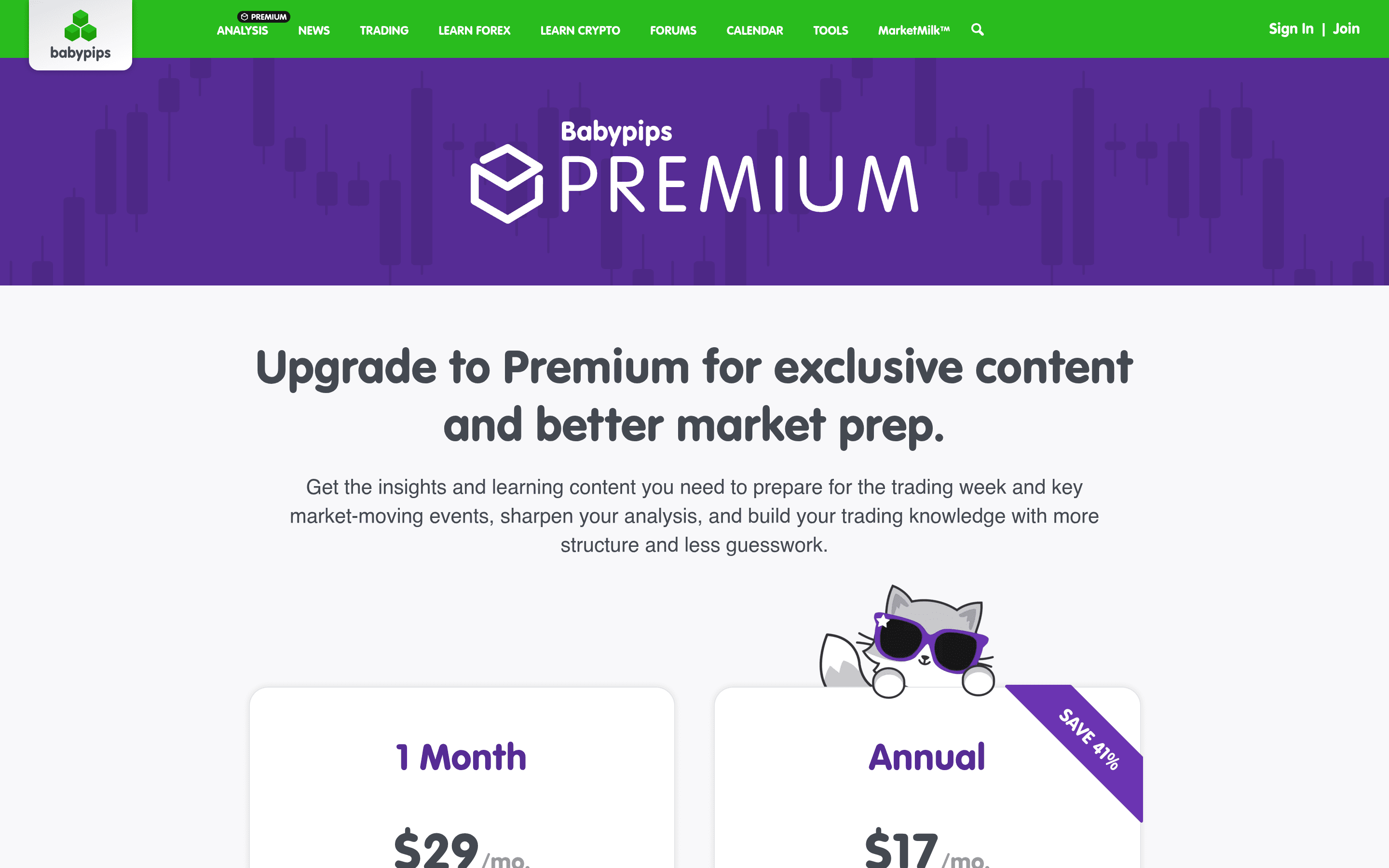
"Such a shame, it was the single most useful course available online that isn't paywalled to death." One r/Forex user wrote that in March 2026, in a thread titled "Babypips course now needs premium for Highschool onwards?". It reads less like a complaint than a small obituary.
The numbers behind it are plain. On 8 April 2026, BabyPips Premium went from $9.99 a month to $29, and from $95.88 a year to $205. At an assumed rate of $1.34 to the pound, that is roughly £21.60 a month, or about £153 a year.
So here is the short answer. The free half of BabyPips is still worth your time, and it remains one of the friendliest plain-English introductions to forex you will find. Premium is worth $29 a month only if what you need next is more theory. If what you need is to see the theory inside a real trade, Systemly (systemly.ai) does that job, and BabyPips was never built to.
Quick answer: BabyPips is still worth it for its free lessons, which cover the basics in clear, friendly English, and it has the bigger free library and the older community. BabyPips Premium, now $29 a month or $205 a year, suits learners who want more reading on price action, macro and risk. Systemly suits beginners who want graded lessons in the same app as a complete trade plan, so every term they learn appears in a real entry, stop, target and position size. Many learners could use the free BabyPips lessons first and Systemly for the step from knowing to doing.
Systemly publishes this comparison. We have tried to be fair to a course we admire, and every competitor fact below is sourced and dated 24 September 2026.
Is BabyPips still free?
More of it is free than the angriest threads suggest. In 2026 BabyPips rewrote the School of Pipsology and moved part of it behind the paywall. A BabyPips promo page now advertises "169 FREE LESSONS". Premium adds "9 advanced modules · 60+ lessons" covering price action, macro, sentiment, intermarket analysis, systems, journaling and risk.
BabyPips has answered the criticism directly. In a reply on Trustpilot, the company wrote that "more than half of all School lessons are still free, along with the accompanying quizzes". That is a fair defence, and on BabyPips' own count of lessons it holds up.
The learners see it differently, and it is worth understanding why. A Trustpilot reviewer wrote on 21 July 2026: "now that most of the lessons requires premium, I can't find another way to learn forex trading." In September 2026 an r/Forex user put the problem more precisely: "its recommended in Wiki to complete it entirely since its free, but i see down the roadmap, important stuff is premium".
Both sides can be right. The early grades are free. The later grades, where vocabulary turns into method, are where the paywall sits, so a beginner meets it just as they start to feel competent.
There is a second change that stings more quietly. On monthly Premium you follow a guided path with required checkpoint quizzes. Only annual subscribers can take lessons in any order. One r/Forex user noted, with the spelling as posted: "Premium is even requiered to 'access lesson in any order'".
What does BabyPips Premium cost now?
Here is the price change, taken from the BabyPips lock-in page and its subscribe page.
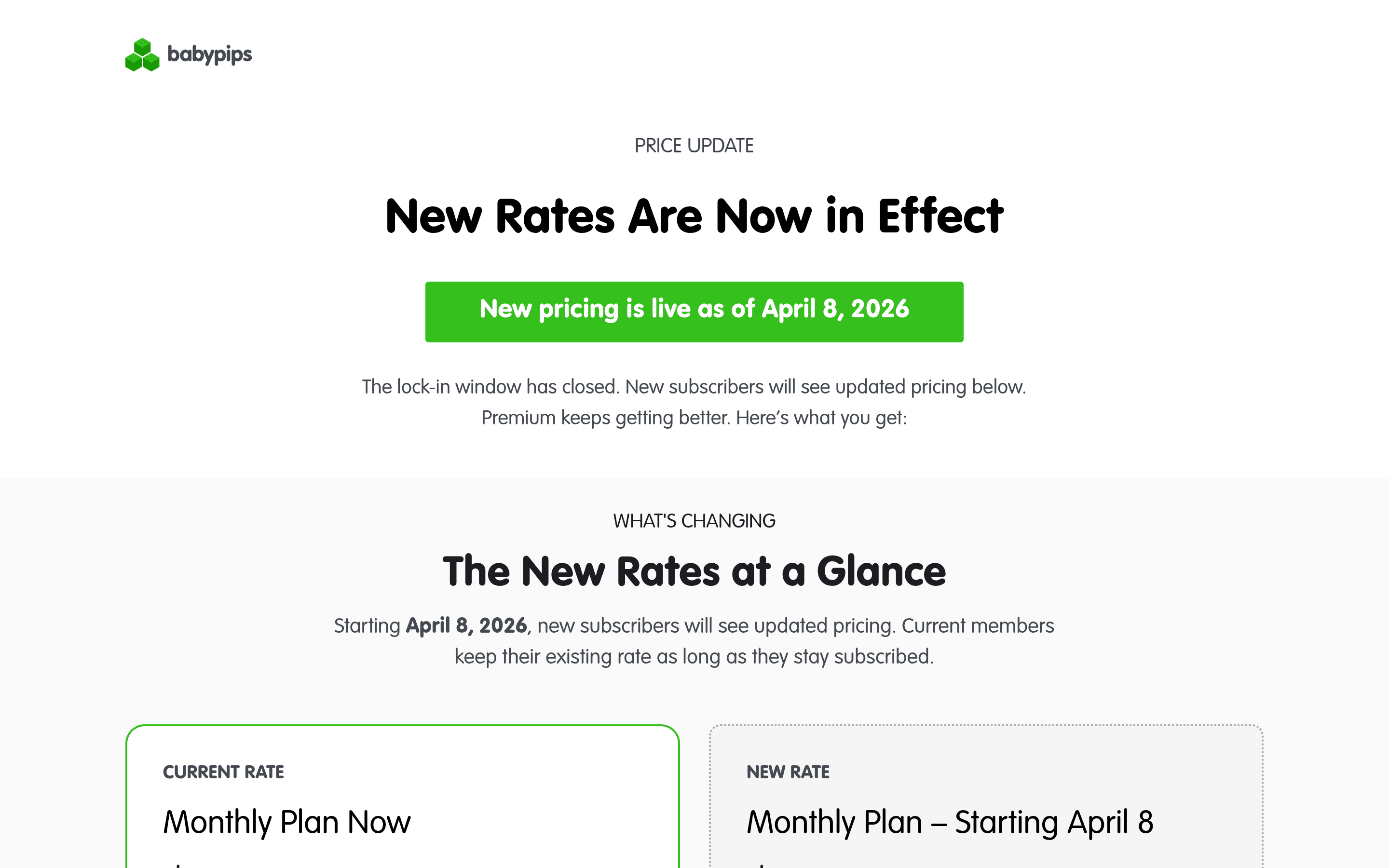
- Monthly Premium: Before 8 April 2026: $9.99 a month; From 8 April 2026: $29 a month
- Annual Premium: Before 8 April 2026: $95.88 a year; From 8 April 2026: $205 a year (about $17 a month)
- Old subscribers: Before 8 April 2026: Keep their old rate while they stay subscribed; From 8 April 2026: Same
Two details matter before you pay. The subscribe page showed $204 a year when we checked, a dollar below the lock-in page, so look at the checkout. And if you joined before 8 April 2026, cancelling to save a month could cost you the old rate for good.
Premium also includes daily analysis, MarketMilk, event guides, no ads and partner discounts. If you would use those, the annual plan at about $17 a month looks different from the headline $29.
Keep one thing in mind as you read on. The last row of the comparison table further down matters most, and BabyPips does not try to fill it.
What BabyPips does brilliantly
It would be easy, and wrong, to write BabyPips off because of a price rise. The School of Pipsology earned its reputation.
It is written in plain English with a friendly tone. It is a text course with illustrations and no video, so you can read it on a bus without headphones. It moves through grade levels from "Preschool" to "Doctorate", which gives a nervous beginner a clear sequence and a sense of progress. There are quizzes at the end of sections. Around it sits a long-standing forum and one of the biggest brands in retail forex. Its Trustpilot rating stands at 4.8 from 443 reviews.
If you have never heard the words "pip", "lot" or "leverage", there are few better free places to meet them. If you want to compare it with other courses first, our list of BabyPips alternatives ranked by what they teach you to do sets nine of them side by side.
What BabyPips was never built to do
BabyPips' most loyal readers are candid about what it is for. One BabyPips forum member described the School this way: "It aims not to teach you how to trade, but rather to provide some basic information about trading." On r/FOREXTRADING another trader wrote: "Babypips are good for a start it won't be enough to transform you into a trader."
A review of the School by TakeProfit notes that the lessons do not connect to real-time charts. That is the gap in one sentence. You read about a stop loss on one page. You meet your first real stop loss somewhere else entirely, on a live chart, with money at risk and nobody marking your answer.
The common mistake is to treat finishing the School as the same thing as being ready to trade. The consequence is a learner who can define "risk-reward ratio" perfectly and still places a 0.10 lot trade on a £500 account because nobody made them do the sum. Think of it like reading a recipe book from cover to cover without ever turning the hob on. You know what a roux is. You have never felt one catch. Our guide to why finishing a theory course does not mean you can place a trade goes further into that gap.
What Systemly does differently
Systemly is a UK-built forex and gold trade-planning app that turns live price data into a complete trade plan, with entry, stop, targets, position size and plain-English reasoning, and teaches the terms in a built-in academy of 32 courses.
That sentence holds two products in one app, and the point is that they are joined.
The Academy has 32 courses, 123 lessons and 642 graded questions, a little under 12 hours of material in all. It covers six subject areas: Foundations, Trading Psychology, Macro & Fundamentals, Technical Analysis, Advanced Tools & Process, and ICT & Smart Money. It is not a video library and it is not a set of PDFs. Every answer is marked, and a handful of wrong ones ends the attempt, so a lesson has to be passed rather than skimmed. It has XP, streaks and achievements, and it works much like Duolingo. The charts inside the lessons are drawn live rather than pasted in as pictures.
The trade plans sit in the same app. You pick an instrument and press scan, and in under a minute you get either a complete plan or a clear statement that there is nothing worth trading right now. The plan gives a direction, an entry, a stop (the price that says the idea was wrong), targets in steps, a position size in lots calculated from the balance and risk percentage you enter, and a plain-English explanation of why, including what would make it fail.
Deterministic code checks every plan the AI drafts: it will not accept a stop narrower than a set minimum, it shifts a stop away from obvious resting liquidity, and it recalculates every distance and the position size itself. Systemly then follows each plan after it is sent and records which level price reached, when, and how far it went against the trade first. That record includes the plans that lose.
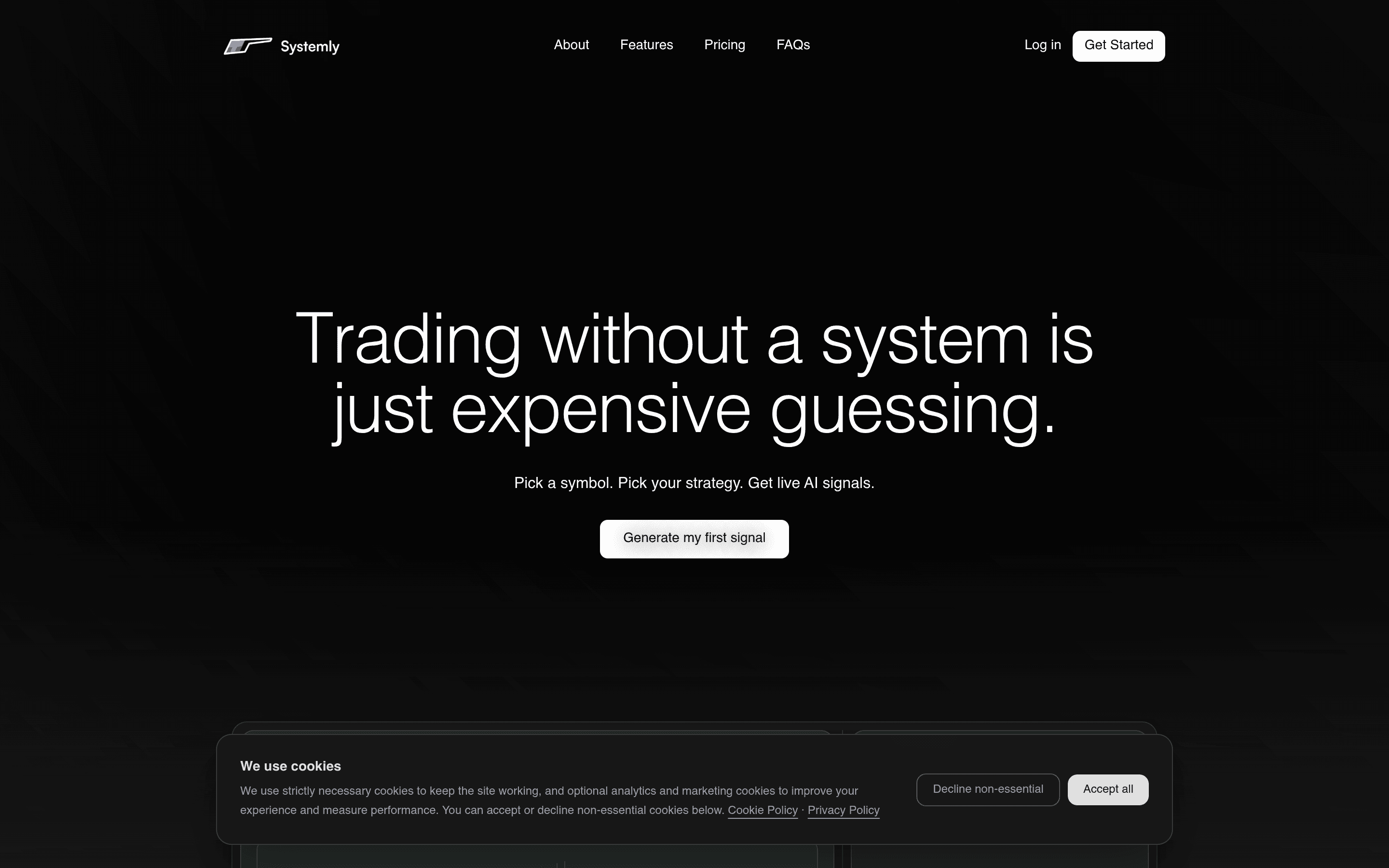
When a term appears in a plan, such as stop, lot, invalidation or liquidity, the lesson that explains it is in the same place. That is the whole design, and you can see it on the Systemly home page.
The same word in two places: an anatomy
Here is that joining in practice. The left column is a field in a Systemly plan, and the right column is the theory you would meet in any beginner course, BabyPips included. This is a generic illustration of the fields, not a real or claimed trade.
- Direction: What the plan tells you: Buy, sell, or nothing worth trading right now; The theory behind it: Trend and market structure
- Entry: What the plan tells you: The price to get in, and why there; The theory behind it: Support, resistance and order types
- Stop: What the plan tells you: The price that says the idea was wrong, and why it sits there; The theory behind it: Stop losses and invalidation
- Targets: What the plan tells you: Where to take money off, in steps; The theory behind it: Risk-reward and scaling out
- Position size: What the plan tells you: Lots for your balance and your risk percentage; The theory behind it: Pips, lots and position sizing
- Reasoning: What the plan tells you: Why the plan exists and what would make it fail; The theory behind it: Building a trading plan
- Outcome record: What the plan tells you: Which level price reached, and how far it went against the trade first; The theory behind it: Journaling and review
Read down the right column and you have most of a beginner syllabus. Read down the left and you have a trade. BabyPips teaches the right column very well. Systemly puts the left column in front of you and keeps the right column one tap away.
A worked example: where the maths lesson meets the trade
Position sizing is the lesson beginners most often skim, and it is the one that decides how much a bad trade costs. Here is the sum, done properly, so you can see why a lesson on its own is not enough.
Take a £500 account. At an assumed rate of $1.34 to the pound, that is about $670. You decide to risk 1% of it, which is $6.70. The idea is a trade on gold with a stop $4.00 away from the entry. Some brokers display that as 400 points and others as 40 pips, and that inconsistency is itself a lesson.
Assume one standard lot of gold is 100 ounces. Contract sizes differ between brokers, so confirm yours before relying on this. A $4.00 move against one full lot costs $4.00 × 100 = $400.
Your size is $6.70 ÷ $400 = 0.01675 lots. The smallest trade most brokers allow is 0.01 lots, so you round down to 0.01. Your real risk is then 0.01 × $400 = $4.00, which is about 0.6% of the account. If you rounded up to 0.02 lots instead, you would be risking $8.00, about 1.2%, which is more than you decided to risk.
A course can teach you that formula. A plan does the sum for your balance every time and shows you the answer next to the reasoning. The free Risk Doctor position-size check looks at a trade's risk and size before you place it, whichever course you learned the formula from.
BabyPips vs Systemly at a glance
This is the table we promised. Note the rows where BabyPips is ahead.
- What it is: BabyPips: A text-based forex course, the School of Pipsology; Systemly: A trade-planning app with a built-in graded academy
- Price: BabyPips: Free lessons; Premium $29 a month or $205 a year from 8 April 2026; Systemly: A free plan that includes part of the Academy; paid plans add alerts, more plans and broker execution. Paid plans start at £9.99 a month (checked 4 October 2026).
- Free library: BabyPips: Bigger: "169 FREE LESSONS" advertised; Systemly: Smaller: part of 123 lessons on the free plan
- Format: BabyPips: Text with illustrations, no video; Systemly: Short graded lessons with live-drawn charts
- How you are tested: BabyPips: Quizzes at the end of sections; Systemly: 642 graded questions; a few wrong answers end the attempt
- Lesson order: BabyPips: Guided path on monthly Premium; any order on annual; Systemly: Six subject areas with XP, streaks and achievements
- Community: BabyPips: Long-standing forum and a huge brand; Systemly: Public feed of community scans; no forum of that age
- Charts: BabyPips: Illustrations; not linked to real-time charts; Systemly: Charts drawn live inside lessons, not pasted in as pictures
- Link to real trades: BabyPips: None; theory only; Systemly: Terms from the lessons appear in complete plans in the same app
That last row is the one our research found no other beginner course filling, and it is the reason we built Systemly the way we did. For the wider picture of free courses, paid courses, broker academies and apps, see our overview of the best way to learn forex trading in the UK.
Is BabyPips Premium worth it?
It depends on what you would do with it, so here is a short decision tree.
- If you have not finished the free grades yet, then Premium is not worth it yet. Finish the free lessons first.
- If you finished the free grades and want more reading on macro, sentiment and intermarket analysis, then Premium's advanced modules are a reasonable buy, especially on the annual plan at about $17 a month.
- If you subscribed before 8 April 2026, then think hard before cancelling, because the old rate only lasts while you stay subscribed.
- If you understand the terms but freeze when a real chart is in front of you, then more theory will not fix it. You need to watch the terms work inside a plan, and you need graded practice.
Where BabyPips is the better choice
BabyPips is the better choice for a complete beginner who wants to read, at their own pace, without being tested. Its free library is bigger than the free part of the Systemly Academy. Its forum has years of answered questions that no new product can match. Its brand is older and better known, and its plain-English, friendly tone is the reason a generation of traders learned the vocabulary there.
If you learn best by reading and are not ready for live charts, start with BabyPips. It is also the better choice for macro and intermarket reading at depth, which its Premium modules are built around.
How we compared
We checked BabyPips' published prices on its lock-in and subscribe pages, its free and premium lesson claims, its Trustpilot rating and its public replies, and what learners said on Reddit and Trustpilot in 2026. We compared those with Systemly's own product facts, and we did not use any Systemly performance figure, because we do not publish one. All facts were checked on 24 September 2026. Prices change, so check each site before you pay.
FAQ
Is BabyPips free?
BabyPips is partly free. In 2026 it moved part of its School of Pipsology behind a paywall, but it still advertises 169 free lessons, and the company says more than half of all School lessons remain free with their quizzes. The early grades are free. Many of the later, more advanced modules on price action, macro, sentiment, systems and risk now need a Premium subscription.
Is BabyPips worth it in 2026?
The free BabyPips lessons are worth it for any beginner who wants clear, friendly explanations of forex basics. Premium, at $29 a month or $205 a year since 8 April 2026, is worth it mainly for learners who want deeper reading on macro, sentiment and intermarket analysis. It does not link its lessons to real-time charts or real trade plans.
How much is BabyPips Premium now?
From 8 April 2026, BabyPips Premium costs $29 a month or $205 a year, which works out at about $17 a month. Before that date it cost $9.99 a month or $95.88 a year. The subscribe page showed $204 a year on 24 September 2026. Subscribers who joined before the rise keep their old rate while they stay subscribed.
Is BabyPips enough to start trading?
BabyPips teaches the vocabulary and the basic ideas of forex very well, but its own community is candid about its limits. One forum member said it aims to provide basic information rather than to teach you how to trade. To move from knowing a term to using it, you need practice on real charts, graded feedback and a demo account.
Does Systemly have a free plan?
Systemly does have a free plan, and it includes part of its academy. A free login also opens the full plans in its public feed of community scans, and paid plans add alerts, more plans and broker execution. Systemly is built for education and trade planning. It does not give financial advice or personal recommendations, and it promises no returns.
Start with the free lessons, then see them in a plan
If you have done the free School and want to see those words working in a real entry, stop and size, start with the graded lessons in the Systemly Academy. Then open a live example in the public feed of community trade scans and read it field by field.
Sources
- BabyPips Premium lock-in page: https://premium.babypips.com/lock-in
- BabyPips subscribe page: https://www.babypips.com/subscribe
- BabyPips on Trustpilot: https://www.trustpilot.com/review/babypips.com
- r/Forex, "Babypips course now needs premium for Highschool onwards?": https://www.reddit.com/r/Forex/comments/1rl7t75/
- r/Forex comment on the wiki and premium roadmap: https://www.reddit.com/r/Forex/comments/1wm4tdw/_/pb4972o/
- BabyPips forum, School of Pipsology: https://forums.babypips.com/t/school-of-pipsology/1228940
- r/FOREXTRADING comment: https://www.reddit.com/r/FOREXTRADING/comments/1w77031/_/p84o0cd/
- TakeProfit review of the School of Pipsology: https://takeprofitapp.com/en/learn/babypips-school-of-pipsology-review
- Systemly: https://www.systemly.ai
- Systemly Academy: https://www.systemly.ai/academy
- Systemly community scans: https://app.systemly.ai/scans
- Systemly Risk Doctor: https://app.systemly.ai/tools/risk-doctor
Trading forex and CFDs carries a high risk of losing money, and most retail accounts do. Systemly is an educational and trade-planning tool. It does not provide financial advice or personal recommendations, and it is not authorised by the FCA to do so. Past outcomes do not predict future results.