
ChatGPT forex trading: can an AI tutor teach you to trade, or do you need an academy?
 Systemly Team
In FCA research covering 666 people aged 18 to 40, published in the summer of 2026, 80% said they had used AI for investment decisions.
The second number is the one that should worry you. Forty-four per cent of the same group wrongly believed that financial information from AI is regulated by the FCA. And 38% said it was fine to make an investment decision on AI alone.
So the question in the title is not hypothetical. If you are reading this, there is a good chance you have already asked a chatbot about a trade. The useful question is what it is good for, and where it quietly lets you down.
ChatGPT is an excellent explainer of trading terms and a poor teacher of trading. It can invent prices, it follows no fixed order, it does not grade you, and it keeps no structured record of what you keep getting wrong. Use it beside a graded course, not instead of one.
Quick answer: ChatGPT is a brilliant explainer: it will define a stop-loss, a lot or a fair value gap in any style you like, at any hour, for free. It is not a trading teacher, because it can make up prices, has no fixed curriculum, does not grade you and does not track the gaps in your knowledge. A structured academy such as the Systemly Academy (32 courses, 642 graded questions) gives you the order and the marking, and its trade plans show each term applied to live price data. The strongest setup is both: a graded course as the spine, and ChatGPT as the patient friend you ask "why?".
Systemly publishes this comparison, and we use AI in our own product, so we are not neutral about it. We have tried to judge ChatGPT on its strengths as well as its flaws, and every competitor fact below is sourced and dated 24 September 2026.
What is ChatGPT good for when you are learning to trade?
ChatGPT is a general-purpose AI chatbot made by OpenAI. It predicts plausible text in reply to what you type, and it does that remarkably well. For a beginner, that makes it one of the most patient explainers you will ever find.
Ask it what "invalidation" means and it will tell you. Ask again "like I'm twelve" and it will simplify. Ask for an example using a cup of tea and it will produce one. It never sighs, never charges by the hour and never makes you feel slow. For the moment when a term in a lesson just will not land, that is genuinely valuable, and we would be foolish to pretend otherwise.
There is a cost argument too. The free tier costs nothing, and the paid tier costs about $20 a month (roughly £15 at an assumed $1.34 to the pound). Many paid trading courses cost far more.
It goes wrong in four places, and they are the four things a course exists to do.
Four places an AI tutor lets a beginner down
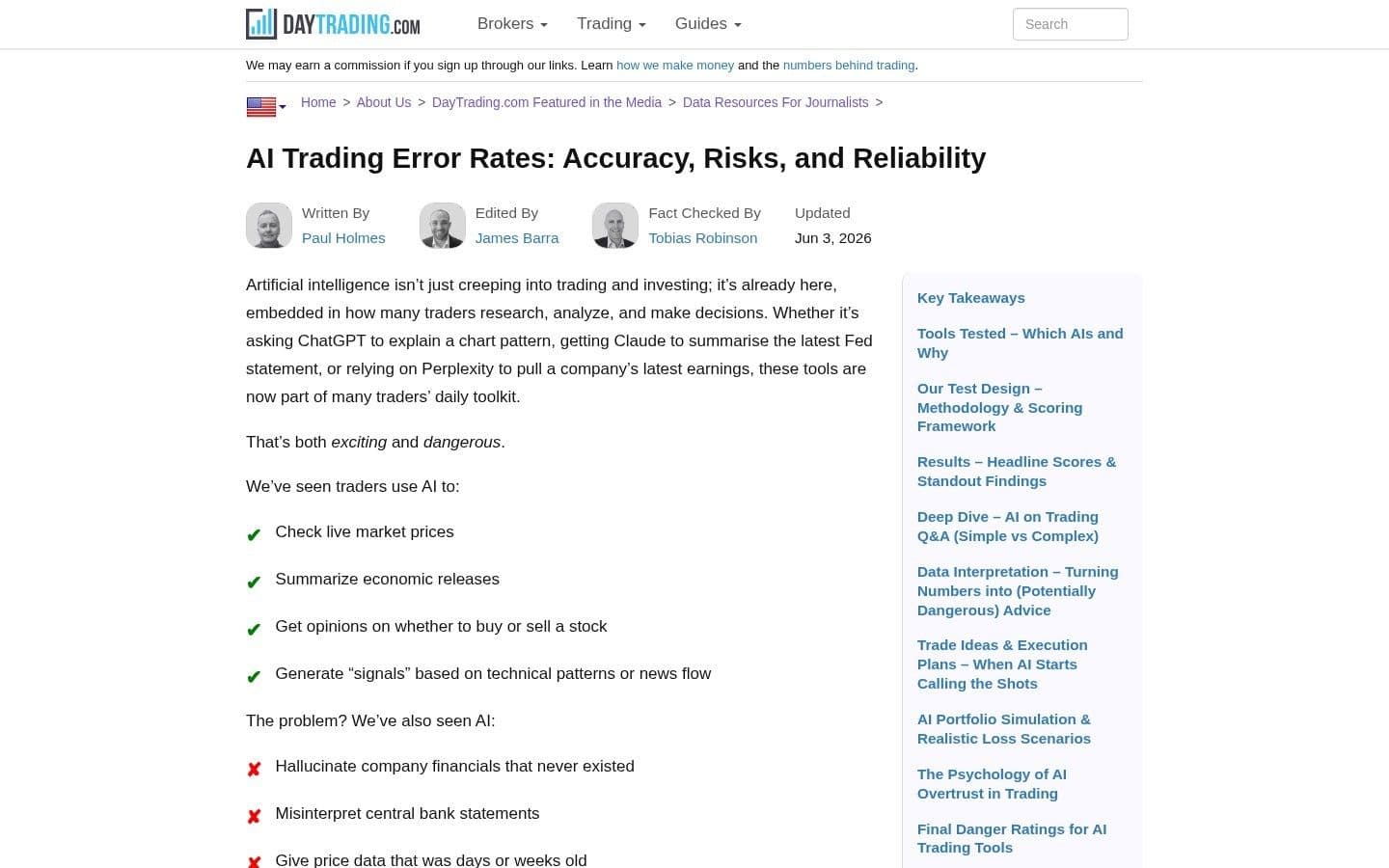
In August 2025, DayTrading.com tested six AI models with more than 180 prompts about trading. It found made-up prices, arithmetic mistakes, pattern errors in about 60% of chart prompts (a descending triangle was called a bull flag) and no risk warnings. That test is not peer-reviewed and comes from a commercial site, so treat it as a warning light rather than a verdict.
1. It can make up prices
The mistake is to ask a chatbot where gold is trading, or where to put a stop, and take the number it gives you. The consequence is a plan built on a price that may never have existed. Unless you paste live data into the conversation, a general chatbot has no live price feed to read from, and it will still answer confidently.
Think of it like asking a well-read friend for today's exchange rate. They know exactly how currencies work. They just have not looked at a screen today, and they will not always say so.
2. It has no sequence
The mistake is learning in the order your questions occur to you. The consequence is a patchwork: you understand order blocks before you understand a lot size, and you can discuss central bank policy but cannot work out your risk on a trade. Courses exist largely to put things in the right order, because some ideas only make sense once others are in place.
It is the same as learning to drive by asking an instructor random questions from the passenger seat. Every answer is correct. You still have never done a hill start.
3. It does not grade you
The mistake is feeling that you understand because the explanation made sense. The consequence is that nothing tests the feeling until the market does, with your money. A chatbot will quiz you if you ask, but it sets the questions, marks the answers and decides how strict to be, all in the same breath.
One r/Daytrading user described their method plainly: "Everything I learned was free on YouTube and I used ChatGPT for everything to confirm my theories." Note the word "confirm". Think of it like asking a friend who wants you to be happy to mark your own exam.
4. It keeps no structured record of your gaps
The mistake is assuming the tool knows what you have not yet grasped. The consequence is that you revisit the ideas you like and skip the ones that trip you up, which for many beginners are sizing and risk. A graded course records what you have passed. A chat window records a conversation.
Is ChatGPT regulated financial advice?
It is not, and that is exactly what 44% of the young people in the FCA's 2026 survey got wrong. AI financial information is not regulated by the FCA simply because it sounds authoritative.
OpenAI itself draws the line. Its published usage policies, effective from 29 October 2025, bar the provision of tailored advice that requires a licence without a professional involved. In other words, the company that makes the tool does not want it acting as your personal adviser either.
Systemly is not regulated advice either. It is an educational and trade-planning tool. It does not give personal recommendations and it is not authorised by the FCA to do so. The difference lies elsewhere, in what the answer is built from and who checks it.
What an AI answer looks like next to an AI-drafted plan
Here is the part most comparisons skip. Systemly uses AI too, so the honest question is not "AI or no AI". It is what the AI is given, and what happens to its answer afterwards.
This table shows what you typically get when you ask a general chatbot about a gold trade, next to the fields of a Systemly plan. The right-hand column is a generic illustration of the fields, not a real or claimed trade.
- Price data: Typical general chatbot answer: Whatever you paste in, or none; Systemly trade plan: Live open, high, low, close and volume bars; scans refused if data is stale, has gaps or carries a future timestamp
- Direction: Typical general chatbot answer: Often a lean one way, with caveats; Systemly trade plan: Buy, sell, or a plain statement that nothing is worth trading right now
- Entry: Typical general chatbot answer: A level, possibly invented; Systemly trade plan: A level taken from the data
- Stop: Typical general chatbot answer: A round number, or a vague "below" a level; Systemly trade plan: "The price that says the idea was wrong", with a minimum width enforced
- Targets: Typical general chatbot answer: One or two levels; Systemly trade plan: Laddered, so money comes off in steps
- Position size: Typical general chatbot answer: Only if you ask, and the arithmetic can slip; Systemly trade plan: Lots worked out from your balance and risk %, then re-derived by code
- Reasoning: Typical general chatbot answer: Fluent and general; Systemly trade plan: Plain English, including what would make the trade fail
- Afterwards: Typical general chatbot answer: Nothing; Systemly trade plan: A record of which level price reached, when, and how far it went against the trade first
The central difference is the order of events. In Systemly, deterministic code reads the chart structure before any model is involved. Most moments do not pass that gate, so the model is never asked to invent a setup when none exists. When the model does answer, the code enforces a minimum stop width, moves a stop that sits on obvious resting liquidity, recomputes every distance, re-derives the position size and runs checks the model cannot see.
The one-line version: "The AI reads the chart. The code owns the trade." A chatbot answer is the AI's opinion. A Systemly plan is an AI draft that code has checked and is prepared to be measured on, including when it loses. We go further into the signals side of this in ChatGPT forex signals vs a purpose-built signal engine.
A worked example: the sum a chatbot can get wrong
Arithmetic mistakes sound harmless until you see what one does to a small account. Here is a sizing question on gold, worked properly, so you can check any answer you are given.
Start with a £500 account, worth about $670 if we assume $1.34 to the pound. You want to risk 1%, which is $6.70. Your stop is $4.00 away from your entry. Your broker may show that as 400 points or as 40 pips, and that inconsistency alone confuses a lot of beginners.
- Take 100 ounces per standard lot as the working assumption, and confirm it against your broker's specification, because it is not universal.
- Multiply the stop distance by the ounces to get the loss on one full lot: $4.00 × 100 = $400.
- Divide the money you are willing to lose by that figure: $6.70 ÷ $400 = 0.01675 lots.
- Round down to a size the broker accepts. Most start at 0.01 lots, and at that size the stop costs 0.01 × $400 = $4.00, roughly 0.6% of the £500.
- Resist rounding up, whether you or a chatbot is doing the sum. At 0.02 lots the same stop costs $8.00, roughly 1.2%, which breaks your own 1% rule and doubles the loss you would take at 0.01.
A chatbot may get this right. It may also skip the rounding step, confuse points with pips or assume a different contract size, and it will present every version with the same calm confidence. Before any trade, run the numbers through the free Risk Doctor tool, which checks a trade's risk and position size before you place it.
ChatGPT vs a structured trading academy
Systemly (systemly.ai) is a UK-built forex and gold trade-planning app that turns live price data into a complete trade plan, with entry, stop, targets, position size and plain-English reasoning, and teaches the terms in a built-in academy of 32 courses.
The Academy has 123 lessons and 642 graded questions across six subject areas, from Foundations to ICT & Smart Money. You answer, it marks you, and a few wrong answers end the attempt. Here is how the two compare as teachers.
- What it is: ChatGPT as a tutor: A general AI chatbot; Systemly Academy and plans: A graded trading academy inside a trade-planning app
- Cost: ChatGPT as a tutor: Free tier; paid tier about $20 a month; Systemly Academy and plans: Free plan includes part of the Academy; paid plans from £9.99 a month (checked 4 October 2026)
- Explains any term on demand, in any style: ChatGPT as a tutor: Yes, and very well; Systemly Academy and plans: Only within its own lessons
- Range of topics: ChatGPT as a tutor: Anything you can think to ask; Systemly Academy and plans: Mainly forex and gold trading, across six subject areas
- A set curriculum: ChatGPT as a tutor: No, you set it as you go; Systemly Academy and plans: Yes, 32 courses in six subject areas
- Marks your answers: ChatGPT as a tutor: Only if you ask, and it marks its own questions; Systemly Academy and plans: Yes, 642 graded questions
- Works from live price data: ChatGPT as a tutor: Only if you paste it in; Systemly Academy and plans: Yes
- Sizes a trade for your balance: ChatGPT as a tutor: Only if prompted, and the arithmetic can slip; Systemly Academy and plans: Yes, and code re-derives the size
- Records what happened afterwards: ChatGPT as a tutor: No; Systemly Academy and plans: Yes, including plans that lost
- Regulated financial advice: ChatGPT as a tutor: No; Systemly Academy and plans: No
ChatGPT wins the first two rows that matter to a curious beginner: it answers any question, in any style, about anything. The last row is a draw, and it should be. Neither tool is your adviser.
How to use ChatGPT well alongside the Academy
Used well, a chatbot makes a course faster and friendlier. Screenshot this list and keep it next to the chat window.
- Ask it to explain, never to predict. "What does invalidation mean?" is a good question. "Will gold go up today?" is not.
- Never take a price from it. If you want it to discuss a level, paste the level in yourself.
- Ask it to rephrase a lesson that did not land. A request such as "Explain liquidity using a queue at a bus stop" plays to its strengths.
- Ask it to quiz you, then check its answers against the lesson rather than trusting its marking.
- Ask it to attack your plan. "What would make this trade fail?" is a far better prompt than "Is this a good trade?", because it pushes against your wish to be agreed with.
- Check every number. Run any lot size through a calculator or Risk Doctor before you trust it.
- Keep your own log of mistakes, because the chat will not keep one for you.
- If it starts telling you to buy or sell, stop. That is not what the tool is for, and its maker's own policies say so.
One Reddit reply to the "ChatGPT made me 8k today" thread on r/Trading put the limit in a single line: "ChatGPT is a glorified next word prediction model, it cannot be used to predict events". That is harsh, but it is the right frame. Use it for words, not for forecasts.
If you are still at the stage of knowing the words but not knowing how to act on them, our guide to the gap between forex theory and practice sets out a 30-day plan that uses exactly this kind of mix.
Where ChatGPT is the better choice
ChatGPT is the better choice in several honest cases.
- You have a specific question that no course lesson covers, such as how a term is used differently on two platforms.
- You need the same idea explained five different ways before it clicks.
- You want to learn about markets beyond forex and gold, such as how shares are valued. The Systemly Academy is built mainly around forex and gold trading.
- You have no budget at all and want a free explainer while you work through free material.
- You are studying the ICT vocabulary and want each term restated in plain English. Our comparison of the ICT mentorship and a structured smart money course includes a glossary you can paste into a chat and ask it to quiz you on.
It is not the better choice for learning the order of things, for being marked honestly, for working with real prices or for sizing a trade.
How we compared
We compared ChatGPT as a trading tutor with the Systemly Academy and its trade plans on cost, range, learning order, grading, access to live data, sizing and record-keeping. Survey figures come from the FCA research reported in July and August 2026, the AI testing figures come from DayTrading.com's August 2025 test, and OpenAI's position comes from its published usage policies. Every figure was checked on 24 September 2026. AI products and their prices change quickly, so check the current versions yourself.
FAQ
Can ChatGPT teach me to trade forex?
ChatGPT can explain forex terms clearly and patiently, which makes it a useful study aid. It cannot reliably teach you to trade, because it can invent prices, follows no fixed curriculum, does not grade you independently and keeps no structured record of your gaps. Many beginners get more from pairing a graded course with ChatGPT as an explainer.
Is ChatGPT good for forex trading?
ChatGPT is good for understanding forex concepts and poor for making trading decisions. A general chatbot has no live price feed unless you paste data in, may make arithmetic mistakes when sizing a trade, and does not track what happened after its answers. OpenAI's own usage policies bar tailored advice that needs a licence without a professional involved.
Is AI financial advice regulated in the UK?
It is not. In FCA research published in 2026, 44% of 18 to 40-year-olds surveyed wrongly believed that AI financial information is FCA-regulated. A chatbot's answer about a trade is not regulated advice and carries none of the protections that regulated advice does. Treat any AI answer about markets as unverified information and check it yourself.
What is the best AI trading tutor?
The best AI trading tutor for a beginner is one that explains terms and also sits inside a structured, graded course. A general chatbot is a strong explainer but has no curriculum or marking. Look for a fixed order, graded questions, live price data and a clear link from each lesson to a real trade decision.
Can ChatGPT calculate lot size?
ChatGPT can calculate lot size if you give it the balance, risk percentage, stop distance and contract size, but it does not use your broker's contract specifications unless you supply them, and it can make arithmetic mistakes. Always check the result. On a £500 account at 1% risk with a $4.00 gold stop and a 100-ounce lot, the correct size is 0.01 lots.
Does Systemly use AI?
Yes. Systemly uses an AI model to draft trade plans, but deterministic code reads the chart structure first and checks the model's answer afterwards. The code enforces a minimum stop width, moves stops off obvious resting liquidity, recomputes distances and re-derives the position size. The short version is: the AI reads the chart, and the code owns the trade.
Give the chatbot a curriculum to answer to
Keep ChatGPT for the "why?" questions, and let a graded course set the order and mark your work. The Systemly Academy is free to start, and you can see how its terms are used in real plans on the public feed of community scans.
Sources
- The Currency Analytics on the FCA study of AI use among 18 to 40-year-olds
- Crowdfund Insider on younger UK consumers' trust in AI (August 2026)
- DayTrading.com AI model test (August 2025)
- OpenAI usage policies
- Reddit r/Trading, "ChatGPT made me 8k today"
- Reddit r/Daytrading, "confirm my theories"
- Systemly
- Systemly Academy
- Systemly Risk Doctor
- Systemly community scans
Trading forex and CFDs carries a high risk of losing money, and most retail accounts do. Systemly is an educational and trade-planning tool. It does not provide financial advice or personal recommendations, and it is not authorised by the FCA to do so. Past outcomes do not predict future results.