
Can ChatGPT trade forex for you? What a chatbot misses, and what a purpose-built trade plan adds
 Systemly Team
A thread on r/Trading carries the title "ChatGPT made me 8k today". It is the kind of title that travels. Somebody shares it, somebody else pastes it into a group chat, and by the weekend a first-year trader with £400 in their account is typing "can chatgpt trade forex for me" into Google.
The line worth keeping came from a reply further down the same thread: "ChatGPT is a glorified next word prediction model, it cannot be used to predict events". It is blunt. On the central point, it is also right.
The short answer is no. ChatGPT is a general chatbot. It does not see live prices unless you paste them in, it does not work out a lot size from your broker's contract unless you ask it to, and it keeps no record of what happened to its ideas. It is a superb explainer. For a forex or gold trade plan built from live data and checked by code, a purpose-built engine such as Systemly (systemly.ai) is the better tool.
Quick answer: ChatGPT cannot trade forex for you, and it is not built to produce a dependable trade plan. It is best for explaining terms, quizzing you and questioning a plan you already have. Systemly is best for a beginner who wants a complete plan from live price data, with the stop checked, the size worked out for their own balance and a record of what happened afterwards. Use ChatGPT as the tutor and a purpose-built engine as the planner.
Systemly publishes this comparison. We have tried to be fair, and every competitor fact below is sourced and dated 24 September 2026.
Why "ChatGPT made me 8k" is the wrong lesson to take
One good day tells you almost nothing about a method. The threads that reach you are the ones where it worked. The trader who asked the same question and lost a week's wages rarely posts a thread about it. One r/FakeGuru user described the same pattern in signal groups: "Everyone there posted their wins after the fact… Never before it happened. Always after."
The habit of asking a chatbot is now mainstream. FCA research published in July and August 2026 surveyed 666 people aged 18 to 40. Of those, 80% had used AI for investment decisions. 44% wrongly believed that AI financial information is regulated by the FCA, and 38% thought it was fine to make a decision on AI alone (The Currency Analytics report on the FCA study; Crowdfund Insider on the same research).
That 44% matters most. ChatGPT is not a regulated adviser, and its maker says so. OpenAI's usage policies, effective 29 October 2025, bar tailored advice that requires a licence unless a qualified professional is involved. Systemly is not a regulated adviser either. It is an educational and trade-planning tool that gives no personal recommendations. So the useful difference between the two lies in what each tool is built to do. Neither carries a badge that makes its output safe to follow blindly.
What happens when you ask ChatGPT for a gold trade?
Picture the evening. Gold has moved sharply, your group chat is loud, and you open ChatGPT and type: give me a gold trade for tomorrow. You will get a fluent, confident answer. Fluency is the product. Four things sit underneath it that the answer rarely tells you.
It has no live price unless you give it one
The common mistake is to treat a well-written answer as a current one. The consequence is a set of levels that may sit nowhere near where gold is trading, so your entry never fills or your stop is already behind you. Think of it like asking a friend for directions over the phone when they cannot see where you are standing. They can describe a route beautifully. They cannot tell you which way to turn at the next junction.
It can invent prices and slip on arithmetic
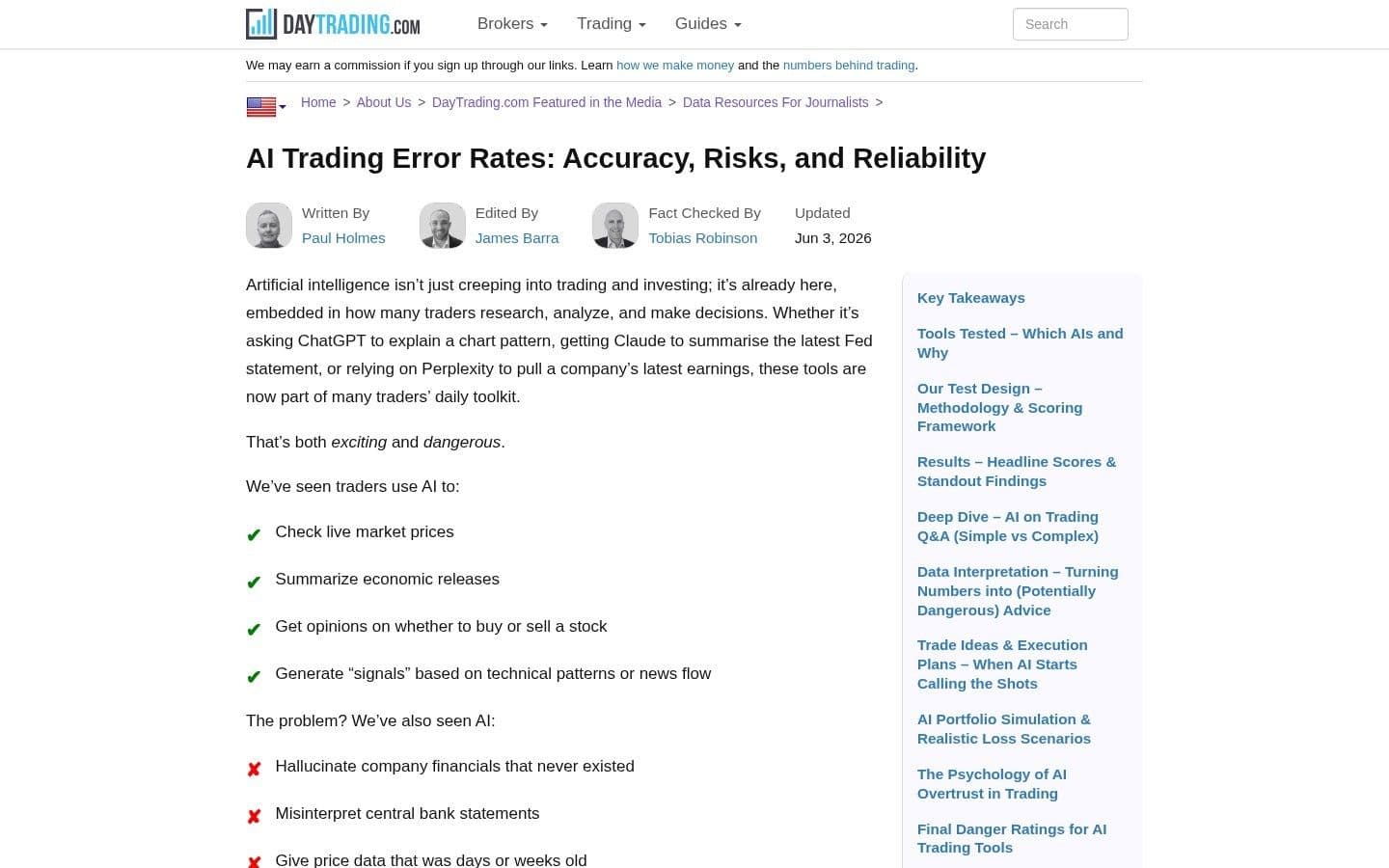
DayTrading.com tested six AI models with more than 180 prompts in August 2025 (DayTrading.com AI test). It found made-up prices, arithmetic mistakes and no risk warnings. About 60% of the chart prompts produced pattern errors, including a descending triangle labelled as a bull flag. That test comes from a commercial site and is not peer-reviewed, so treat it as a warning light rather than a verdict.
It does not size the trade for your broker's contract
This is the gap that costs beginners money. ChatGPT does not compute a lot size from your broker's contract specification unless you prompt it with every input. Most people never do. Here is what the calculation involves on gold, using stated assumptions.
- Start with the contract. We assume 100 ounces of gold per standard lot. Your broker may use something else, so look up its gold specification before relying on this.
- Take a £500 account. At an assumed exchange rate of 1.34, that is about $670.
- Risk 1% of it. That is $6.70.
- Put the stop $4.00 away from the entry. Some brokers display that as 400 points and others as 40 pips.
- Over that $4.00, a full 1.00 lot gains or loses $4.00 × 100 oz = $400.
- The size is $6.70 ÷ $400 = 0.01675 lots.
- The minimum lot is usually 0.01, so you round down to 0.01. Your real risk is 0.01 × $400 = $4.00, about 0.6% of the account. Round up to 0.02 instead and the risk doubles to $8.00, roughly 1.2%.
A chatbot can do that sum if you feed it the contract size, the exchange rate, your balance, your risk and the stop. It cannot know your broker's contract, and the DayTrading.com test found arithmetic errors anyway. We walk through the whole method, including a real Reddit case where the numbers went wrong, in our guide to gold position sizing.
It keeps no record of what happened
ChatGPT does not log outcomes. Ask it tomorrow whether yesterday's idea worked and it has no way to know unless you tell it. The mistake is to judge a source by how convincing it sounds. The consequence is that you never learn whether its ideas were any good, so you cannot learn from them either. It is the same as a weather forecaster who never looks out of the window to check whether it rained.
What a chatbot answer leaves out, field by field
The clearest way to see the difference is to lay the fields side by side. The left column describes what a general chatbot answer to "give me a gold trade" typically covers when nobody has fed it data. The right column describes the fields a Systemly plan always fills. Neither column is a real trade. It is an illustration of structure.
- Direction: Typical chatbot answer: A bias, often hedged; Fields in a Systemly plan: Buy, sell, or nothing worth trading right now
- Entry: Typical chatbot answer: Often a vague area; Fields in a Systemly plan: One entry level
- Stop: Typical chatbot answer: A general idea, such as above resistance; Fields in a Systemly plan: The price that says the idea was wrong, checked by code
- Targets: Typical chatbot answer: A single broad aim; Fields in a Systemly plan: Laddered targets, taking money off in steps
- Size: Typical chatbot answer: Missing unless you ask; Fields in a Systemly plan: Lots for your own balance and risk %
- Reasoning: Typical chatbot answer: Fluent and general; Fields in a Systemly plan: Plain English, including what would make it fail
- Afterwards: Typical chatbot answer: Nothing; Fields in a Systemly plan: Which level price reached, when, and how far it went against the trade first
Notice the first row. A tool that can say "nothing worth trading right now" is doing something a chatbot finds very hard. A chatbot is built to answer. Ask it for a trade and it will usually give you one.
The AI reads the chart. The code owns the trade.
Systemly uses AI too, so it would be dishonest to present this as humans against machines. The difference is who has the final say. Systemly is a UK-built forex and gold trade-planning app that turns live price data into a complete trade plan, with entry, stop, targets, position size and plain-English reasoning, and teaches the terms in a built-in academy of 32 courses. It works from live market price data: the open, high, low, close and volume of each bar. It does not read chart screenshots, and we compare that screenshot approach separately in our breakdown of AI chart analysis apps.
Here is what the code does around the AI, in plain English.
- It checks the data first. A scan is refused if the price data is out of date, has gaps, or carries a timestamp from the future. Think of it like a chef who checks the ingredients are fresh before anyone starts cooking.
- It reads the shape of the market before any AI model is involved. Most moments do not pass this first check. When nothing is worth trading, the AI is never asked to invent a setup.
- It sets a minimum width for the stop. A stop placed too close to the entry tends to be knocked out by ordinary back-and-forth movement, so the code will not accept one that is too tight.
- It moves a stop that sits on an obvious crowd of other people's stops. Just beyond a recent high or low is where many traders park their stops, and price often reaches those levels before it moves on. The code shifts the stop away from that spot.
- It measures every distance again itself: entry to stop, entry to each target. It does not take the AI's numbers on trust.
- It works out the position size again from the balance and risk % you entered, so the same plan shows a different size for every user.
- It runs further checks that the AI cannot see, so the model cannot talk its way around them.
- After the plan is sent, it follows the trade. It records which level price reached, when it got there, and how far price went against the trade first. It measures its own plans against real price, including the ones that lose.
The plan arrives in under a minute. You can see what a finished plan looks like in the public feed of community scans; the full plan needs a free login.
ChatGPT vs a purpose-built trade plan engine
- Explaining any trading concept in plain English: ChatGPT (general chatbot): Excellent, on almost any topic; Systemly (purpose-built engine): Good, focused on the terms in its plans and Academy
- Source of prices: ChatGPT (general chatbot): Only what you paste in; Systemly (purpose-built engine): Live market price data, bar by bar
- Refuses stale or broken data: ChatGPT (general chatbot): No; Systemly (purpose-built engine): Yes: stale, gappy or future-dated data is refused
- Can say there is nothing to trade: ChatGPT (general chatbot): Rarely; it is built to answer; Systemly (purpose-built engine): Yes, and most moments do not pass the first check
- Stop checked for width and crowded levels: ChatGPT (general chatbot): No; Systemly (purpose-built engine): Yes, by code after the AI answers
- Lot size from your balance and risk: ChatGPT (general chatbot): Only if you supply every input; Systemly (purpose-built engine): Worked out and re-checked by code
- Record of outcomes: ChatGPT (general chatbot): None; Systemly (purpose-built engine): Follows each plan, including losers
- Range of subjects: ChatGPT (general chatbot): Almost unlimited; Systemly (purpose-built engine): Mainly forex and gold trade planning, plus the Academy
- Cost: ChatGPT (general chatbot): Free tier; paid tier about $20 a month; Systemly (purpose-built engine): Free plan; paid plans add alerts, more plans and broker execution
- Regulated to give advice: ChatGPT (general chatbot): No; Systemly (purpose-built engine): No; it is an educational and planning tool
Two rows favour ChatGPT outright: explanation and range. The last row is a draw, and it is a draw that matters. Neither tool is an adviser, so neither should be the only voice in your head.
When ChatGPT is the better choice
ChatGPT is the better choice when you want to understand something rather than decide something. It will explain a fair value gap five different ways until one of them lands. It will rephrase a paragraph from a textbook at eleven at night without sighing. It will quiz you on a term, and it will cover subjects Systemly does not touch, from tax basics to the history of a currency peg.
It is also better for someone who is curious about markets in general and has no intention of placing a trade soon. For that person, a free chatbot and a library card go a long way. We look at how to use it as a teacher, and where a structured course does better, in our comparison of ChatGPT as a trading tutor and a structured academy.
How to use ChatGPT well alongside a trade plan
The best use of a chatbot is as a second pair of eyes on something that already exists. Screenshot this list if it helps.
- Paste in a finished plan and ask it to explain each field in plain English.
- Ask it what would make the trade fail, and compare its answer with the reasoning in the plan.
- Ask it to quiz you on the terms in the plan: stop, lot, invalidation, liquidity.
- Never ask it for a current price. Take prices from your platform.
- Never let it move your stop. If it suggests a different stop, ask why, and then check the reasoning yourself.
- Check any lot size it gives you with a separate tool such as the free Risk Doctor position-size check, which checks a trade's risk and position size before you place it.
- Write down what happened after every trade. The chatbot will not do this for you.
And a short decision tree for the moment you are tempted.
- If you want to know what a term means, then ask ChatGPT.
- If you want a trade idea with an entry, a stop and a size, then use a tool built from live data and check the size before you place anything.
- If ChatGPT and your plan disagree, then do not trade until you understand why.
- If you cannot explain the trade to a friend in two sentences, then you are not ready to place it.
Systemly's Academy sits inside the same app as the plans, which helps with that last step. It has 32 courses, 123 lessons and 642 graded questions. Lessons are graded as you go, and a handful of wrong answers ends the attempt, so you have to pass each lesson rather than skim it. When a word such as "invalidation" appears in a plan, the lesson that explains it is one tap away in the Systemly Academy.
How we compared
We compared a general chatbot with a purpose-built engine on the tasks a beginner actually asks of them: where the prices come from, whether the stop is checked, how the size is worked out, and whether outcomes are recorded. Facts about ChatGPT come from OpenAI's published policies, the FCA research reported in July and August 2026, and the DayTrading.com test from August 2025. Facts about Systemly come from its own product documentation and landing page. All facts were checked on 24 September 2026, and prices and features change, so check them before you rely on them.
FAQ
Can ChatGPT trade forex for me?
No. ChatGPT is a general chatbot. It does not see live prices unless you paste them in, it does not size a trade for your broker's contract unless you give it every input, and it keeps no record of what happened. It can explain trading concepts very well. It should not be the thing that decides your entry, your stop or your size.
Are ChatGPT forex signals reliable?
There is no track record to judge, because ChatGPT does not log outcomes. A commercial test by DayTrading.com in August 2025 found made-up prices, arithmetic mistakes and pattern errors in about 60% of chart prompts across six AI models. Treat any trade idea from a chatbot as a draft to question, never as a signal to follow.
Can ChatGPT do forex analysis from live prices?
Only if you supply the prices yourself, and then only as well as the data you paste in. It will not know whether that data is stale or incomplete. Purpose-built tools such as Systemly work from live price bars and refuse to produce a plan when the data is out of date, has gaps or carries a future timestamp.
Is AI trading advice regulated by the FCA?
No. FCA research published in 2026 found that 44% of 18 to 40-year-olds wrongly believe AI financial information is FCA-regulated. OpenAI's usage policies bar tailored advice that needs a licence unless a qualified professional is involved. Systemly is not FCA-authorised either. It is an educational and planning tool that gives no personal recommendations.
What is the difference between ChatGPT and Systemly?
ChatGPT is a general chatbot that answers almost any question in fluent English. Systemly is a trade-planning app, built mainly for forex and gold, that builds a plan from live price data, then has code check the stop, recompute every distance and work out the size for your balance. It also records what happened after each plan, including the ones that lose.
Can ChatGPT calculate lot size for gold?
It can do the arithmetic if you give it the contract size, your balance, your risk, the stop distance and the exchange rate. Assuming 100 ounces per lot, a £500 account risking 1% with a $4.00 stop works out at 0.01675 lots, which rounds down to 0.01. Always check your broker's contract specification, because contracts vary.
If you arrived looking for a chart image analyser, we have set the two approaches side by side, including the cases where an image reader is the better choice.
Try a plan that shows its working
If you want to see what a trade plan looks like when the code owns the stop and the size, start on Systemly's free plan and run your first scan, then paste the plan into ChatGPT and ask it to explain every line.
Sources
- r/Trading, "ChatGPT made me 8k today": https://www.reddit.com/r/Trading/comments/1j34zds/
- r/FakeGuru thread on signal groups: https://www.reddit.com/r/FakeGuru/comments/1ulo1ks/
- FCA study coverage, The Currency Analytics: https://thecurrencyanalytics.com/regulations/fca-study-80-of-young-uk-investors-use-ai-tools-but-most-think-its-regulated-287887
- FCA study coverage, Crowdfund Insider: https://www.crowdfundinsider.com/2026/08/302195-younger-uk-consumers-reportedly-trust-ai-more-than-finfluencers-and-media-for-investment-advice/
- OpenAI usage policies (effective 29 October 2025): https://openai.com/policies/usage-policies/
- DayTrading.com AI model test (August 2025): https://www.daytrading.com/ai/test
- Systemly: https://www.systemly.ai
- Systemly Academy: https://www.systemly.ai/academy
- Systemly community scans: https://app.systemly.ai/scans
- Systemly Risk Doctor: https://app.systemly.ai/tools/risk-doctor
Trading forex and CFDs carries a high risk of losing money, and most retail accounts do. Systemly is an educational and trade-planning tool. It does not provide financial advice or personal recommendations, and it is not authorised by the FCA to do so. Past outcomes do not predict future results.