
IG Academy review: should you learn to trade from your broker, or from an independent tool?
 Systemly Team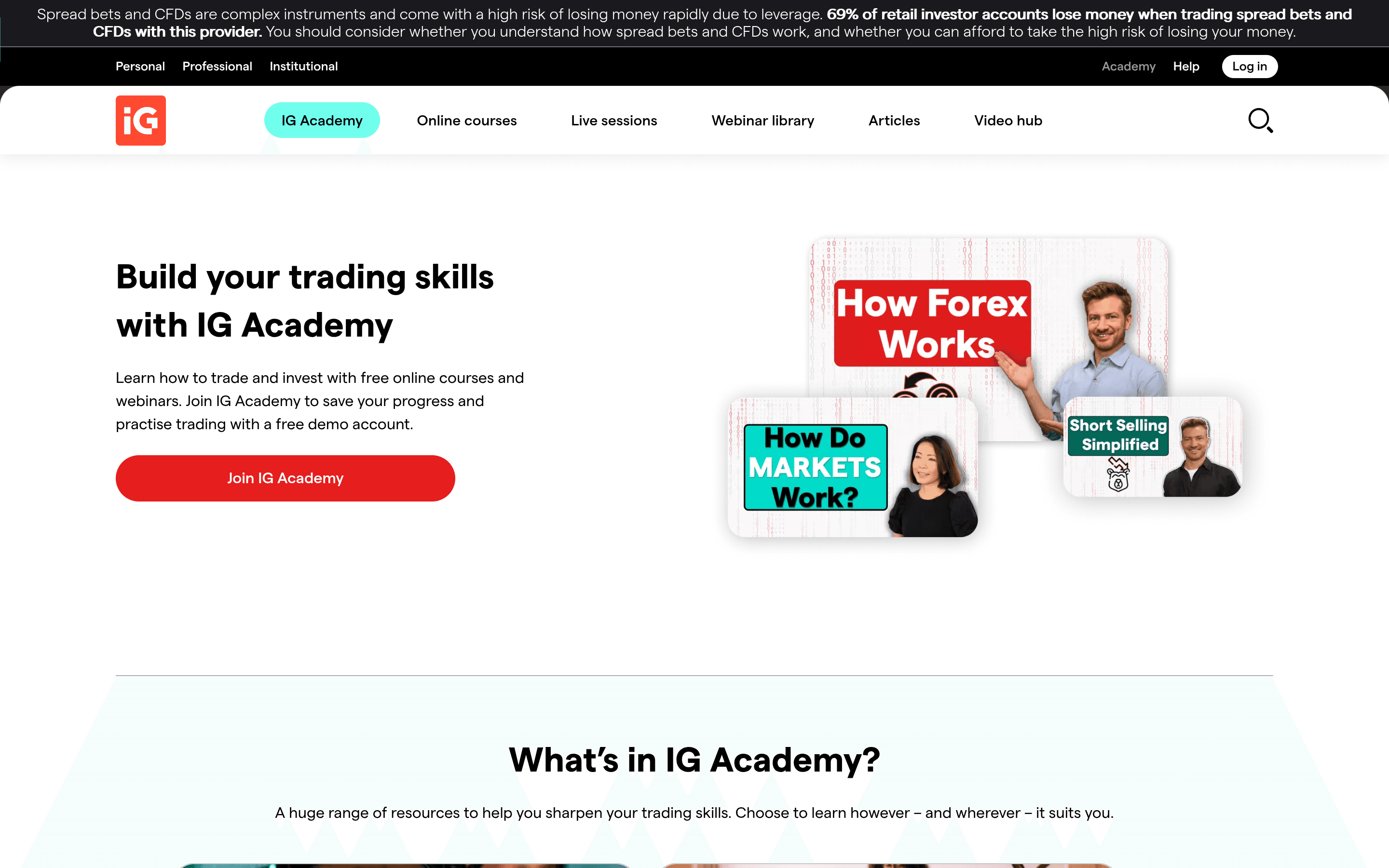
You type "free forex course uk" into your phone on the bus home. Near the top of the results is a broker's academy. The videos are tidy, the quizzes are friendly, and a progress bar remembers exactly where you stopped last night.
It is free, and it is good. Somewhere on the same site is a number the firm is required to publish: the share of its retail CFD accounts that lose money. For IG, that number is 69%.
Both facts are true at once, and that is the whole question of this article.
Broker academies such as IG Academy and eToro Academy are free, well made and run by regulated firms, and they are a sensible place to learn the basics. Their structural weakness is that the teacher earns when you trade. An independent learning tool is not run by the firm that executes your trades, and that is the gap Systemly is built for.
Quick answer: IG Academy is one of the best free broker academies, with videos, interactive exercises, quizzes and saved progress, and eToro Academy adds a $100,000 virtual portfolio. Both are run by regulated firms and cost nothing. Their limitation is structural: a broker earns when you trade, so its academy naturally leads towards a live account. The Systemly Academy is not run by a broker, grades you with 642 questions, and shows each term inside a real trade plan, which suits beginners who want to learn before they feel any pull to trade.
Systemly publishes this comparison, and we are the independent option in its title. We have tried to be fair to the brokers, and every competitor fact below is sourced and dated 24 September 2026.
What is IG Academy?
IG Academy is a free online trading course run by IG, a UK broker that offers CFDs. According to IG's own academy page, it combines videos, interactive exercises and quizzes, and saves your progress as you go. The app carries a 4.8 rating.
That is a strong offer for the price of nothing. The teaching is structured, the exercises make you do something rather than only watch, and you can pick up where you left off. For a beginner who wants to know what a pip, a spread or a margin call is, IG Academy is a solid and trustworthy starting point.
The published share of IG's retail CFD accounts that lose money is 69%. That figure describes IG's clients, not its teaching, and we come back to what it does and does not tell you below.
What is eToro Academy?
eToro Academy is the free education arm of eToro, a trading platform that also offers copy trading. It offers videos, articles and courses, and a $100,000 virtual portfolio so you can practise without real money.
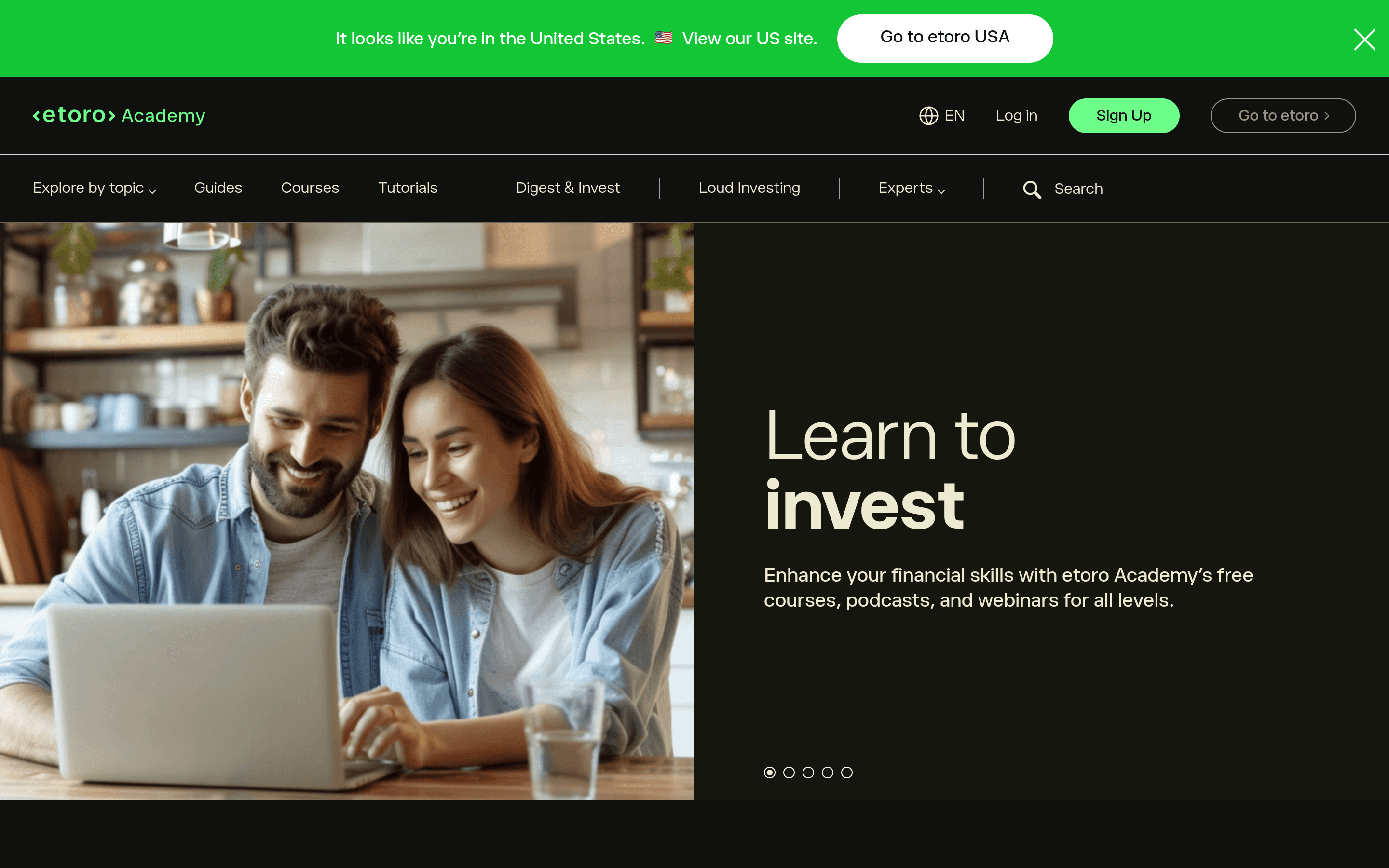
The virtual portfolio is a genuine strength. Practice without consequences is how most skills start. It also contains a trap for small accounts, which the worked example later in this article sets out in numbers.
eToro's published share of retail CFD accounts losing money is 52%, according to BrokerChooser on 17 September 2026.
What is Capital.com Investmate?
Investmate is a free learning app owned by Capital.com, a CFD broker. It offers more than 30 courses with lessons of about three minutes, quizzes and a paper-trading simulator, and it is rated 4.8 from 2.1K ratings on the App Store. One recurring complaint is that you cannot review the questions you got wrong.
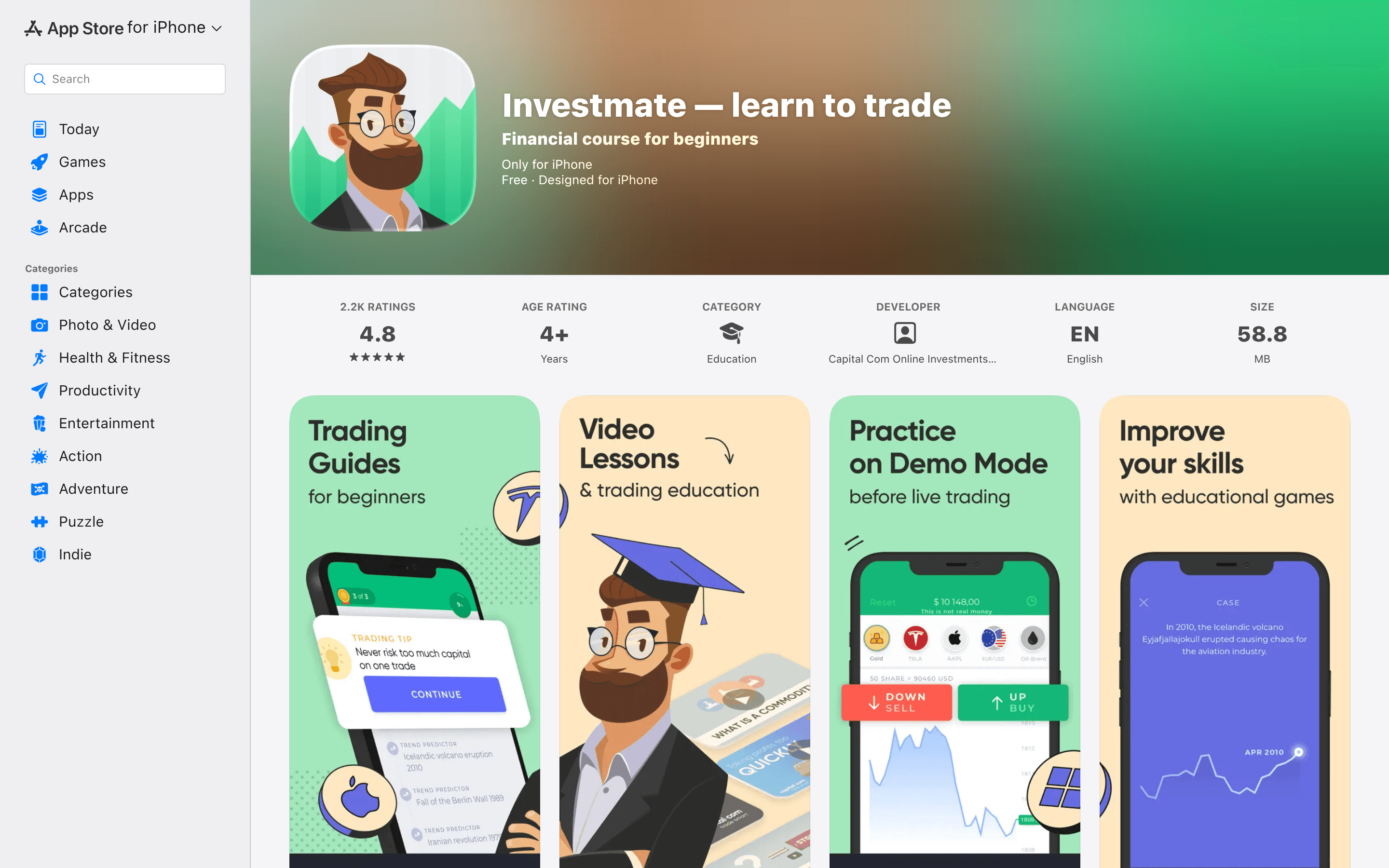
That complaint matters more than it sounds. A wrong answer is the most useful moment in any lesson. If you cannot go back and see why you got it wrong, the quiz tells you that you failed but not what to fix. Capital.com's published share of retail CFD accounts losing money is 79.75%.
We compare Investmate with other gamified apps, including Finelo and Trading Game, in is there a Duolingo for trading.
What the published loss percentages tell you
Since 1 August 2019, under the FCA's permanent CFD rules, firms selling CFDs to UK retail clients must publish the percentage of their retail accounts that lose money. The same rules cap leverage at between 30:1 and 2:1, close out positions at 50% margin and give retail clients negative balance protection.
Here are the figures we recorded for brokers that are commonly named alongside education offers.
- IG: Education offer: IG Academy: videos, interactive exercises, quizzes, saved progress; Share of retail CFD accounts losing money: 69%
- eToro: Education offer: eToro Academy: videos, articles, courses, $100,000 virtual portfolio; Share of retail CFD accounts losing money: 52% (BrokerChooser, 17 September 2026)
- CMC Markets: Education offer: Knowledge Hub; Share of retail CFD accounts losing money: 68%
- Pepperstone: Education offer: Guides and webinars; Share of retail CFD accounts losing money: 72.9%
- OANDA: Education offer: Videos, ebooks and webinars; Share of retail CFD accounts losing money: 76.6%
- Capital.com: Education offer: Investmate app; Share of retail CFD accounts losing money: 79.75%
Two cautions before you read too much into this. First, these percentages describe each firm's client base, which differs in size, products and experience. They are not a league table of teaching quality. Second, even the lowest figure here means more than half of that firm's retail CFD accounts lose money. In September 2025 the FCA put it more broadly: "80% of customers lose money when investing in CFDs."
The honest reading is simple. No free course changes the fact that most retail CFD accounts lose money. Whoever teaches you, the most important lesson is how to keep losses small while you learn.
The structural point: who earns when you trade
This is the heart of the comparison, and it is about business models, not about the people who write the lessons.
The mistake: assuming free means neutral
The common mistake is to treat a free broker course as neutral, the way you might treat a library book. The consequence is subtle. A broker's revenue grows when clients trade, so the natural next step at the end of every lesson is a trading account, and the gentle pressure of the whole experience is towards starting sooner. None of this requires anyone to act in bad faith. It is simply where the incentives point.
Think of it like a maths class run by a bookmaker. The teacher may be brilliant and the maths entirely correct. You would still notice that the classroom has a betting counter by the door, and that every lesson on probability ends a few steps from it.
The wider system of incentives
Around the brokers sits a wider layer of affiliates and introducers. Introducing-broker rebates are paid per standard lot that a referred trader trades, which, as one affiliate industry explainer puts it, rewards "volume persistence". FX News Group reported that in a December 2022 letter to CFD broker chief executives, the FCA warned: "Some affiliates market themselves as FX 'educators' and 'signals providers.'"
That warning is not about IG Academy or eToro Academy. It is about the ecosystem a beginner walks into. Education is one of the routes by which new traders reach brokers, which is why it pays to know who benefits from each lesson you take.
Practice money versus your money: a worked example
eToro Academy's $100,000 virtual portfolio is generous. Here is why it can also mislead.
Say you practise sensibly and risk 1% per trade. On the virtual portfolio, 1% is $1,000. Now say your real account will be £500. At an assumed $1.34 to the pound, that is about $670, and 1% is $6.70.
The virtual account lets you risk about 149 times more per trade than your real one ($1,000 ÷ $6.70 = 149).
On gold, the gap becomes concrete. Assume 1 standard lot is 100 ounces (brokers vary, so check your own contract specification) and a stop $4.00 from entry. That stop costs $400 per 1.00 lot.
- Virtual portfolio: $1,000 ÷ $400 = 2.5 lots.
- Real £500 account: $6.70 ÷ $400 = 0.01675 lots, which rounds down to the usual minimum of 0.01, putting $4.00 at risk, or about 0.6% of the balance.
On the virtual account you get used to trading 2.5 lots. On the real one, the only size that keeps you near 1% is the smallest trade the broker allows. Nudge it up to 0.02 and the risk becomes $8.00, about 1.2%. That jump from practice habits to real constraints is where a first account can get hurt.
The fix is to practise with the balance you will actually have, if your demo account allows it. You can check the risk and position size of any trade before placing it with the free Risk Doctor tool.
What an independent learning tool does differently
Systemly (systemly.ai) is a UK-built forex and gold trade-planning app that turns live price data into a complete trade plan, with entry, stop, targets, position size and plain-English reasoning, and teaches the terms in a built-in academy of 32 courses.
Systemly is not a broker. It does not offer CFDs, and your trading account stays with whichever broker you use. Systemly has a free plan; its paid plans add alerts, more plans and broker execution. If you choose, that execution connects to your own MT5 account, but it is optional.
Being independent changes three practical things.
- A plan can tell you not to trade. Every Systemly scan returns either a direction or a plain statement that there is nothing worth trading right now, and most moments do not pass the checks. That answer is part of the product, not a footnote.
- The lessons connect to real decisions. The Academy runs to 32 courses, 123 lessons and 642 graded questions. When a term such as stop, lot, invalidation or liquidity appears in a plan, the lesson that explains it is in the same app. Our research found no competing learning app that links graded lessons to a live trade plan with lot sizing.
- The record includes the losses. Each plan is tracked after it is sent: Systemly logs which level price reached, when, and the worst move against the trade along the way, and the losing plans stay in the record.
In fairness, Systemly has a commercial incentive too: it wants you on a paid plan. So judge it the way you would judge a broker academy, by what it does when there is nothing worth trading and by whether it keeps the plans that lost in its record. You can look at finished plans on the public feed of community scans.
Broker academies vs the independent option
- Cost: IG Academy: Free; eToro Academy: Free; Capital.com Investmate: Free; Systemly Academy: Free plan includes part of the Academy; paid plans from £9.99 a month (checked 4 October 2026)
- Run by: IG Academy: IG, a CFD broker; eToro Academy: eToro, a trading platform; Capital.com Investmate: Capital.com, a CFD broker; Systemly Academy: Systemly, an independent app that is not a broker
- Regulated firm: IG Academy: Yes; eToro Academy: Yes; Capital.com Investmate: Yes; Systemly Academy: No, Systemly is not authorised by the FCA
- Format: IG Academy: Videos, interactive exercises, quizzes; eToro Academy: Videos, articles, courses; Capital.com Investmate: 30+ courses, lessons of about 3 minutes, quizzes; Systemly Academy: 32 courses, 123 lessons, 642 graded questions
- Practice money inside the product: IG Academy: Not listed in the academy description; eToro Academy: Yes, $100,000 virtual portfolio; Capital.com Investmate: Yes, paper-trading simulator; Systemly Academy: No; pair it with a demo account
- Public app rating we could cite: IG Academy: 4.8; eToro Academy: Not found for the academy alone; Capital.com Investmate: 4.8 from 2.1K; Systemly Academy: None we can cite
- Lessons linked to a live trade plan with sizing: IG Academy: No; eToro Academy: No; Capital.com Investmate: No; Systemly Academy: Yes
Systemly is weaker on three rows here: it is not a regulated firm, it has no built-in practice money, and it has no public rating we can point to. Those are real gaps, and for some readers they will decide the matter.
If you are deciding right now
- If you want a free, polished introduction to trading vocabulary and do not mind the broker context, IG Academy is a strong fit.
- If you want virtual money inside the same app, eToro Academy and Investmate offer that. Set your practice size to match your real balance.
- If you already have a broker and want lessons that connect to trade plans, sizing and a record of outcomes, the Systemly Academy fills that gap without changing your broker.
- If you are not sure you should trade at all yet, learn somewhere that gives you value without asking you to open a trading account.
For a ranked view of every route, from free courses to AI tutors, see the best way to learn forex trading in the UK.
Where a broker academy is the better choice
Broker academies are the better choice in several real cases.
- You want a free course with years of polish behind it, from a regulated firm.
- You want built-in virtual money to practise with, which eToro Academy and Investmate include and Systemly does not.
- You learn well from video and short, friendly quizzes, and IG Academy's saved progress suits how you study.
- You want lessons on shares or indices as well as currencies. The Systemly Academy is built mainly around forex and gold.
- You simply want the basics and have no plan to trade soon, in which case the incentive question matters much less.
How we compared
We compared IG Academy, eToro Academy, Capital.com's Investmate and the Systemly Academy on cost, who runs them, regulation, format, practice money, ratings, incentives and whether the lessons link to real trade plans. Broker education details and loss percentages come from each firm's pages, the App Store and BrokerChooser, and the regulatory context comes from the FCA. The figures were checked on 24 September 2026. Loss percentages are updated regularly and course content changes, so check each firm's own site for current figures.
FAQ
Is IG Academy free?
Yes. IG Academy is free to use and combines videos, interactive exercises and quizzes, with saved progress so you can continue where you stopped. It is run by IG, a UK broker that offers CFDs. You can learn from it without trading, but its natural next step is a trading account, because that is how IG earns.
Is IG Academy any good?
IG Academy is one of the stronger free broker academies, with structured lessons, interactive exercises, quizzes, saved progress and an app rated 4.8. It is a solid way to learn trading vocabulary. Its main limitation is structural: IG earns when clients trade, and 69% of IG's retail CFD accounts lose money according to the firm's published figure.
What is eToro Academy?
eToro Academy is the free education section of eToro, a trading platform that also offers copy trading. It offers videos, articles, courses and a $100,000 virtual portfolio for practice. eToro's published share of retail CFD accounts losing money was 52% according to BrokerChooser on 17 September 2026. Practise with a virtual balance close to your real one.
Can I learn forex for free in the UK?
Yes. Free options include broker academies such as IG Academy and eToro Academy, Capital.com's Investmate app, BabyPips' free lessons and the free plan of the Systemly Academy, which includes part of its graded courses. Free routes cost time rather than money, so choose one with a clear order and quizzes, and practise on a demo account first.
Why do brokers offer free trading courses?
Brokers offer free trading courses because education brings in new clients, and brokers earn when clients trade. That does not make the courses bad. Many are well made and come from regulated firms. It does mean the course is designed by a business that benefits when you start trading, so keep your own pace.
Is Systemly a broker?
No. Systemly is not a broker and does not offer CFDs. It is an educational and trade-planning app that builds trade plans from live price data and teaches the terms in a graded academy. There is a free plan, and paid plans add alerts, more plans and the option to connect your own MT5 account.
Learn first, on your own timetable
If you want to learn the terms, see them used in real plans and decide in your own time whether to trade at all, start with the free plan of the Systemly Academy. Before paying for a course of any kind, it is also worth reading what popular forex courses cost per lesson.
Sources
- IG Academy
- Capital.com Investmate on the App Store
- FCA permanent restrictions on CFDs for retail consumers
- Cellxpert on forex affiliate and IB programmes (July 2026)
- FX News Group on the FCA's letter to CFD broker CEOs
- eToro loss figure: BrokerChooser, 17 September 2026
- Other broker loss figures: each firm's published figure, as compiled on 24 September 2026
- Systemly
- Systemly Academy
- Systemly Risk Doctor
- Systemly community scans
Trading forex and CFDs carries a high risk of losing money, and most retail accounts do. Systemly is an educational and trade-planning tool. It does not provide financial advice or personal recommendations, and it is not authorised by the FCA to do so. Past outcomes do not predict future results.