
Backtesting vs paper trading: Bar Replay, FX Replay and Forex Tester, or forward practice?
 Systemly Team
It is Sunday evening. You open a gold chart, wind it back three months with a replay tool and press play. Candles step forward one at a time. By midnight you have taken 40 trades on your new setup, and the results look wonderful.
On Monday you watch the live chart for the same setup. It does not appear on Monday. On Tuesday it half appears, and you are not sure. On Wednesday it appears during a meeting. By Friday you have one trade, and you hesitated before taking it.
Nothing was wrong with your Sunday. It answered a different question. Backtesting tells you whether a set of rules could have worked on past prices. Forward paper trading tells you whether you can follow those rules in real time, when you do not know what happens next. You need both answers.
Quick answer: Backtesting with TradingView Bar Replay, FX Replay or Forex Tester Online is the better choice for testing a rule on months of history quickly, and Forex Tester adds a prop challenge simulator. Forward paper trading is the honest test of whether you can follow the rule live, without hindsight. Systemly does no backtesting and has no bar replay, but it is the stronger place to practise forward, because it gives you a plan, an Academy that explains it and a paper account with real spreads and costs. Backtest first, then practise forward.
Systemly publishes this comparison. We have tried to be fair, and every competitor fact below comes from the provider's own pages, checked 18 October 2026.
Backtesting, bar replay and paper trading: the plain definitions
Backtesting is testing a trading rule on past prices to see how it would have behaved. It can be automatic, where software runs the rule over years of data, or manual, where you step through old charts and decide trade by trade.
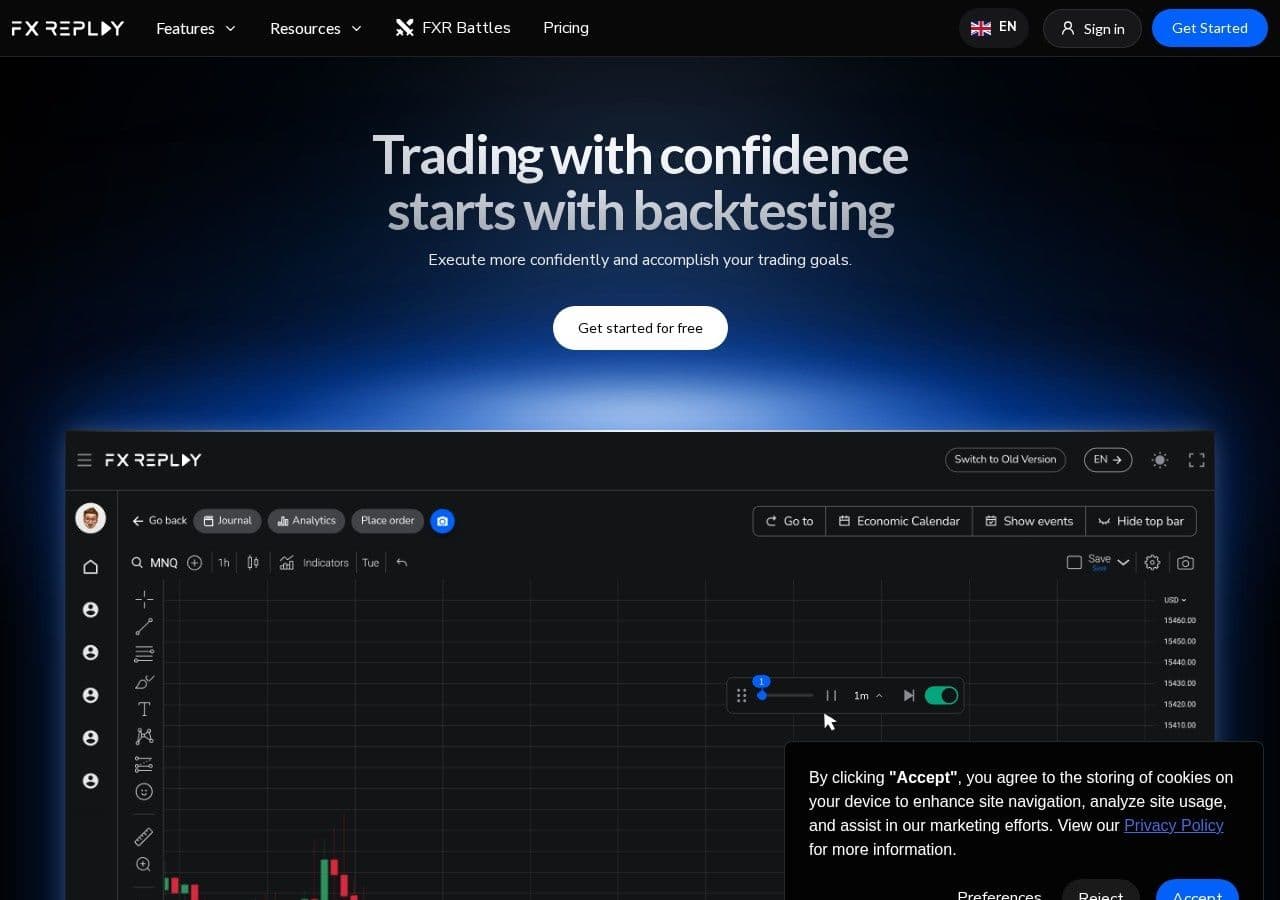
Bar replay is the manual kind. A replay tool hides the chart to the right of a chosen date and reveals one candle at a time, so you can practise decisions on history.
Forward paper trading is taking trades on live prices as they happen, with virtual money. You cannot fast-forward. You wait for the setup, like you would with real money.
Systemly (systemly.ai) is a UK-built forex and gold trade-planning app that turns live price data into a complete trade plan, with entry, stop, targets, position size and plain-English reasoning, and teaches the terms in a built-in academy of 32 courses. Its paper account is forward only. It has no replay mode and does no backtesting.
The three replay tools
TradingView Bar Replay
TradingView's Bar Replay replays past bars from a start point you choose, step by step. Replay Trading is "a separate trading mode from Paper Trading". It lets you set starting capital, currency and commission, and its trade data and results "are not saved anywhere", although the replay session itself is saved when you exit. Orders placed with Paper Trading during a replay execute on real-time data, not on the replayed bars (TradingView: Bar Replay and TradingView: learn to trade on historical data).
How much history you can replay depends on your plan. TradingView's October 2024 blog said Plus gives 6 months of 1-minute data in replay, and Premium and above give deep history (TradingView blog). The official pages we checked did not say plainly what the free Basic plan includes, so check yours before relying on it.
Best for: a quick manual replay on the charting platform you already use.
FX Replay
FX Replay is a browser replay and backtesting tool for traders. Its free Beginner tier gives 2 sessions, 50 trades per session, 1-month session length and 1 week of data retention. The Intermediate and Pro tiers are listed at $180 and $350 a year (shown as $15 and $29.16 a month), or $17.99 and $35 billed monthly, so check the price at checkout (FX Replay pricing).
Best for: structured replay sessions with a free tier to try first.
Forex Tester Online
Forex Tester Online is a browser backtesting tool built around tick data. It claims 23 years of history across more than 270 instruments, and includes a journal, a pre-trade checklist and a Prop Challenge Simulator with daily loss limits and drawdown rules. There is a free demo and a 30-day money-back guarantee; prices are not shown on the features page (Forex Tester Online features).
Best for: serious manual backtesting, including rehearsing prop challenge rules on history.
Replay tools vs forward paper trading compared
- What it tests: TradingView Bar Replay: Your rules on past bars; FX Replay: Your rules on past bars; Forex Tester Online: Your rules on past tick data; Systemly paper trading: Your rules on live prices, going forward
- Time to 50 trades (our estimate): TradingView Bar Replay: An evening or two; FX Replay: One free session holds 50 trades; Forex Tester Online: An evening or two; Systemly paper trading: Weeks or months; you wait for each setup
- History: TradingView Bar Replay: Depends on plan; deeper intraday on paid plans; FX Replay: Free tier with 1-month sessions; Forex Tester Online: Claims 23 years, 270+ instruments; Systemly paper trading: None; no replay at all
- Can you see the future?: TradingView Bar Replay: Hidden, but you may remember the chart; FX Replay: Hidden, but you may remember; Forex Tester Online: Hidden, but you may remember; Systemly paper trading: No; it has not happened yet
- Costs: TradingView Bar Replay: Commission setting you choose; FX Replay: Not stated on the pricing page; Forex Tester Online: Not stated on the features page; Systemly paper trading: Real spreads and costs; swap and slippage at labelled, assumed figures
- Results saved: TradingView Bar Replay: Replay Trading results "not saved anywhere"; FX Replay: Free tier keeps data 1 week; Forex Tester Online: Journal included; Systemly paper trading: Trades dashboard keeps history; no inactivity expiry, and a reset keeps old accounts readable
- Prop rules: TradingView Bar Replay: Not stated; FX Replay: Not stated; Forex Tester Online: Prop Challenge Simulator; Systemly paper trading: Daily and weekly loss limits
- A plan to test: TradingView Bar Replay: You bring your own; FX Replay: You bring your own; Forex Tester Online: You bring your own; Systemly paper trading: Entry, stop, targets and size drawn for you
- Teaching: TradingView Bar Replay: Not part of replay; FX Replay: Not stated; Forex Tester Online: Not stated; Systemly paper trading: The Systemly Academy, 32 courses
- Speed of results: TradingView Bar Replay: Instant as you step; FX Replay: Instant as you step; Forex Tester Online: Instant as you step; Systemly paper trading: Checked every 15 minutes, so not built for scalping
- Open positions: TradingView Bar Replay: Not stated; FX Replay: 50 trades per free session; Forex Tester Online: Not stated; Systemly paper trading: Free plan: 3 open paper trades
- Cost to start: TradingView Bar Replay: Depends on plan; check yours; FX Replay: Free tier; paid from $180 a year; Forex Tester Online: Free demo; prices not shown; Systemly paper trading: Free plan
Systemly loses several rows outright. It has no history, no replay and no way to gather 50 trades in an evening. If you want to know whether a rule worked on 2024 gold, Systemly cannot tell you. That is a job for the first three columns.
Hindsight bias: why replay results look better
The common mistake is to treat a good replay result as proof. The consequence is a trader who goes live with confidence the record never earned.
Replay hides the future candles, but it cannot hide what you already know. If you lived through those three months of gold, part of you remembers that it rallied. You lean long without meaning to. You skip the setup that "looked messy", and later find it was a loser you avoided by memory, not by rule. Each of these choices is small. Together they flatter the result.
There is also look-ahead error, which affects any manual backtest. A common example is reading a daily candle as finished when, at the time of your entry, it still had hours left to run. Another is drawing a support line through swing lows that, on the day of the trade, had not yet formed.
Think of it like rereading a mystery novel when you already know who did it. The clues look obvious, and you feel clever spotting them. A reader seeing it for the first time would have suspected three other people.
Forward paper trading removes that advantage, because the future has not happened. It is slower, and it is honest. Systemly adds one more guard. If you scan the same market and style again within 15 minutes, it reopens the last answer rather than rolling the dice for a new one, unless a major release has come out since. You cannot fish for the plan you wanted.
Worked example: time and costs
Two numbers explain why both methods have a place.
The first is time. Say your setup appears about three times a week on the pairs you watch. To collect 50 forward trades, you need 50 ÷ 3 = 16.7 weeks, so about 17 weeks. In replay, you might take 50 in one long evening. That is why replay is the right place to throw out a bad rule quickly, and forward paper is the right place to confirm a good one.
The second is costs. Suppose a replay session runs with commission switched off and you do not think about spreads. On EUR/USD, a 1-pip spread on a 0.20-lot trade costs 0.20 × $10 × 1 = $2. Over 50 trades that is $100. On a £1,500 account, about $1,950 at an illustrative 1.30, that is 100 ÷ 1,950 = about 5.1% of the account, gone before a single stop is hit.
Then there is overnight swap. A forex position held past the daily rollover pays or earns a small amount, and on Wednesday it is usually charged three times. A rule that holds trades for days can look better without it.
Example, not a signal. On Systemly's paper account, spreads and trading costs are included, and swap is charged at an assumed, labelled figure, tripled on Wednesday. A limit order only fills if price actually trades through it, and a candle that touches both stop and target counts as the stop. These rules are strict on purpose, so that practice does not flatter you in the ways a cost-free replay can.
What the research says about feedback
Practice helps most where feedback is quick and the rules are stable. In a McKinsey interview with Daniel Kahneman, Gary Klein said "you shouldn't trust the judgments of stock brokers picking individual stocks", calling such settings low-validity (McKinsey: when can you trust your gut). Markets are noisy, so a small run of good results proves little.
A study of 3,103 retail forex traders found that after small random gains, traders took more trades, about 55% more after a small gain than after a small loss, even though past wins did not predict future ones (Ben-David, Birru and Prokopenya, NBER, 2016). A glowing replay session is exactly that kind of feedback. Practise the process, and judge it on whether you followed it, not on how the equity line looked.
Where Bar Replay, FX Replay or Forex Tester is the better choice
- You want to test a new rule fast. Replay gives you dozens of trades in an evening; Systemly gives you none from history.
- You want to see a rule across different years. Forex Tester's claimed 23 years of tick data covers market conditions forward practice would take years to meet.
- You want to rehearse a prop challenge on history. Forex Tester's Prop Challenge Simulator is built for it.
- You want to practise reading candles one at a time. Bar Replay sits inside the charting platform many traders already use.
- You scalp. Replay shows each tick or bar as you step, while Systemly checks paper results every 15 minutes.
- You want to throw away bad ideas cheaply. Replay finds a broken rule in hours, not months.
Use them for that. Our guide to TradingView free vs paid plans compares the plans.
The sensible order: backtest, then practise forward on Systemly
Here is a loop that uses each method for what it does best.
- Learn the rule properly. In the Systemly Academy, take Top-down and Support and resistance from the Technical Analysis strand, then Using it honestly and The checklist from Advanced Tools and Process. The whole catalogue of 32 courses opens on Starter, Plus and Pro; the free plan opens 40 lessons across 7 whole courses plus tasters.
- Backtest it elsewhere. Use a replay tool to see whether the rule ever worked. Drop it if it fails on history.
- Generate a plan forward. Open the market live and press Generate. In under a minute the plan appears on the chart, with entry, stop, targets, the moves card and one money figure with costs included. Read "Why this trade". If the checks fail, you get "no trade" and the reasons.
- Press Execute and choose Paper. The confirm dialog says "Paper trade. No real money." The trade is sized against your paper balance, set once at the size you will really trade, with your risk limits applied.
- Let it run and review. Alerts arrive in the app and by browser notification for fills, targets and stops, and results are checked every 15 minutes. The trades dashboard shows balance, equity and risk in use, with stats that show their base, such as "12 closed trades". Then work through the Journal and review course and compare the forward record with your backtest.
If the forward record looks much worse than the replay, that gap is the lesson. Usually it is hindsight, costs or hesitation. Paper results stay private, are labelled simulated and do not predict live results. Our guide to journalling paper trades explains what to record.
What neither method fixes
Neither replay nor forward paper trading puts real money at risk, so neither teaches how a real loss feels. A forward paper record is more honest than a replay, but it is still a rehearsal. Expect live trading to feel different, and read why demo results and live results part company before you make the jump.
How we checked
We read TradingView's Bar Replay help pages and blog, FX Replay's pricing page and Forex Tester Online's features page on 18 October 2026, and took every competitor detail from them. FX Replay's page shows both annual and monthly prices, which we report as shown. We did not test any tool's fills or data quality ourselves. Systemly's features come from its own product documentation, and prices and plans change, so check each provider before you pay.
FAQ
What is the difference between backtesting and paper trading?
Backtesting tests a trading rule on past prices, either automatically or by replaying old charts one candle at a time. Paper trading takes trades on live prices with virtual money, so you cannot see what happens next. Backtesting is fast and covers more history. Paper trading is slower but free of hindsight, so it shows whether you can follow the rule in real time.
Is backtesting or paper trading better for beginners?
Both have a place, in order. Backtest a rule first to check it ever worked, because replay can reject a bad idea in an evening. Then paper trade it forward to see whether you can follow it live, with costs, waiting and doubt included. Beginners who only backtest often overrate a rule, because memory and hindsight flatter the result.
Is TradingView Bar Replay free?
It depends on your plan, and the official pages we checked on 18 October 2026 did not say plainly what the free Basic plan includes. TradingView said in October 2024 that Plus gives 6 months of 1-minute replay data and Premium and above give deep history. Replay Trading is separate from Paper Trading, and its results are not saved anywhere, so record them yourself.
How much does FX Replay cost?
FX Replay has a free Beginner tier with 2 sessions, 50 trades per session, 1-month sessions and 1 week of data retention. On 18 October 2026, its pricing page listed Intermediate at $180 a year or $17.99 a month, and Pro at $350 a year or $35 a month. The annual prices are also shown as $15 and $29.16 a month. Check the price at checkout.
What is hindsight bias in backtesting?
Hindsight bias is when knowing what happened makes a past decision look easier than it was. In manual backtesting, you may remember how a market moved, lean towards the right direction and skip setups that later failed. The result looks better than the rule deserves. Forward paper trading avoids it, because the future has not happened yet when you decide.
How many trades do you need to test a strategy?
There is no agreed minimum. Figures such as 30, 50 or 100 trades circulate among educators, but we found no authoritative source for a statistically proven number. Treat a few dozen trades as too few to tell skill from luck. At three setups a week, 50 forward trades take about 17 weeks, which is why many traders backtest first.
Can you backtest on Systemly?
No. Systemly has no bar replay and does no backtesting. It is a forward tool: it builds a trade plan on live price data, and its paper account lets you practise that plan with real spreads and costs, results checked every 15 minutes. Use a replay tool such as TradingView Bar Replay, FX Replay or Forex Tester Online for history.
Test the past, then practise the future
Use a replay tool to test your rule on history. Then start forward paper trading on Systemly's free plan and see real plans in the community feed. The two courses that turn a backtest into a forward routine, Using it honestly and The checklist in the Systemly Academy, open on Starter, and Plus adds the 4H and slower charts a swing trader needs to forward-test on the timeframe they backtested. All three paid plans start with a 3-day free trial.
If your backtest needs ten indicators to work, read about analysis paralysis and too many indicators, and our guide to confluence in trading. For judging any record honestly, see why signal win rates mean less than you think, our checklist for how long to paper trade and the TradingView paper trading comparison. The rest is on Systemly's home page.
Sources
- TradingView, Bar Replay: how and why to test a strategy in the past
- TradingView, learn to trade on historical data
- TradingView blog, deep intraday data in Bar Replay (October 2024)
- FX Replay, pricing
- Forex Tester Online, features
- Pepperstone, what are swaps and how to calculate them
- McKinsey, strategic decisions: when can you trust your gut
- Ben-David, Birru and Prokopenya (2016), Uninformative Feedback and Risk Taking, NBER
- Systemly, Systemly Academy and community plans
Trading forex and CFDs carries a high risk of losing money, and most retail accounts do. Paper trading uses no real money, and paper results do not predict live results. Systemly is an educational and trade-planning tool. It does not provide financial advice or personal recommendations, and it is not authorised by the FCA or licensed in the UAE or elsewhere to do so. Past outcomes do not predict future results.