
Gold signals on Telegram: what a real XAUUSD signal leaves out, line by line
 Systemly Team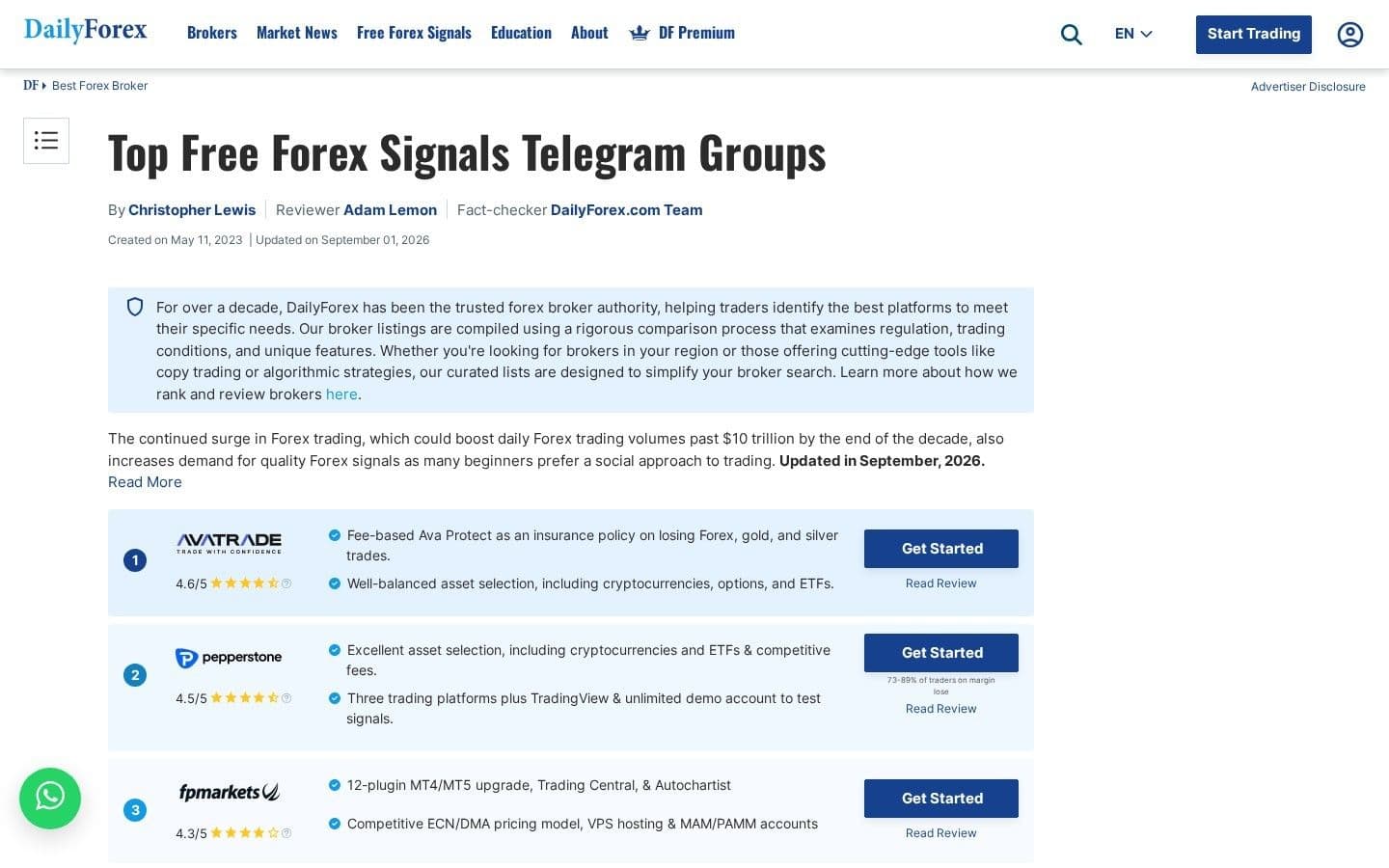
"Sell Gold @2502-2506 Sl :2508 Tp1 :2500 Tp2 :2498 Enter Slowly-Layer"
That is the whole message. A beginner posted it to r/Forexstrategy to ask what other people made of it. It is six numbers and a short instruction, and it has the same shape as most gold calls that reach a beginner's phone.
So is a signal like this enough to trade on? It tells you which way someone thinks gold is going. It does not tell you how much to trade, why the stop sits where it does, or what happened to the channel's last ten calls. A complete trade plan fills those gaps. For a beginner, the gaps are where the money goes.
Quick answer: A typical Telegram gold signal gives an entry zone, a stop and two targets, and leaves out position size, reasoning and any record you can check. It can suit an experienced trader who already sizes and judges their own trades. Systemly suits a beginner who wants the same fields filled in for their own balance, with the reasons in plain English and every outcome recorded, including the losses. Neither removes risk. The difference is how much of the decision you can see.
Systemly publishes this comparison. We have tried to be fair, and every competitor fact below is sourced and dated 24 September 2026.
What does a Telegram gold signal actually tell you?
Read the signal once more, as if you had to place it with your own money in the next five minutes. There are five instructions in it: sell, a zone, a stop, two targets, and "enter slowly, layer". There is one instruction missing, and it is the one that decides whether a bad trade costs you $4 or $40. We will get to it a few sections down, because it only makes sense once you have seen what the zone does to your risk.
The levels themselves belong to the day the signal was posted. Ignore the prices and look at the shape. The shape is what repeats.
The entry zone: 2502 to 2506
The signal gives a range, not a price. A write-up on gold signal channels by VasilyTrader lists entry zones instead of exact prices as one of the common tactics, alongside several take-profit levels and one-minute screenshots.
A zone sounds flexible. In practice it means the channel has not told you which trade you are taking, because where you get filled changes the whole trade. Here is the same signal from three fill prices. All figures are in dollars of gold price movement.
- 2502: Distance to stop (2508): $6; Distance to TP1 (2500): $2; Distance to TP2 (2498): $4; Break-even hit rate at TP1: 75%
- 2504: Distance to stop (2508): $4; Distance to TP1 (2500): $4; Distance to TP2 (2498): $6; Break-even hit rate at TP1: 50%
- 2506: Distance to stop (2508): $2; Distance to TP1 (2500): $6; Distance to TP2 (2498): $8; Break-even hit rate at TP1: 25%
The last column is the share of trades you would need to win just to stand still, before costs, if you always closed at the first target. It is the stop distance divided by the stop plus the target. At 2502 that is 6 ÷ (6 + 2) = 75%. At 2506 it is 2 ÷ (2 + 6) = 25%.
One message has produced three different trades. At the bottom of the zone you need to be right three times in four; at the top, once in four. The channel will still count all three as a single call.
"Enter slowly, layer"
Layering means splitting your position into several orders across the zone. The common mistake is to treat it as a careful, low-risk way to enter.
The consequence is the opposite. This is a sell signal, so the orders higher up the zone only fill if price rises towards your stop. The scenario in which you end up holding the full position is the scenario in which the trade is going wrong.
Here are the numbers. Assume one standard lot of gold is 100 ounces, so 0.01 lots is one ounce and moves $1 for every $1 move in gold. Place three sell orders of 0.01 lots at 2502, 2504 and 2506. If all three fill and the stop at 2508 is hit, you lose $6 + $4 + $2 = $12. On a £500 account (about $670 at an assumed rate of 1.34 dollars to the pound), that is about 1.8% of the account on one idea. A single 0.01-lot order at the middle of the zone would have lost $4.
Think of it like a restaurant that adds another dish to your order every time the kitchen runs late. The bill gets bigger at exactly the moment the evening is going worst.
The stop: 2508
The stop sits $2 above the top of the zone. There is no reason attached to it.
A useful definition of a stop is "the price that says the idea was wrong". That definition only works if you know what the idea was. Is 2508 above a recent swing high? Is it just a round distance from the entry? Is it sitting where a lot of other traders' stops are resting, the kind of level where stops are commonly hunted? The message cannot tell you. A stop with a reason can be judged. A stop without one can only be trusted.
The targets: 2500 and 2498
Two targets let a channel report partial success. If price reaches 2500 and then turns, TP1 is "hit" even if the trade later stops out for anyone who held on.
There is a second problem, and one r/trading212 user spelled it out: "some of their entry prices actually do not execute because the gold price did not reach it. But they will still use that entry price to count toward their TP levels" (r/trading212).
Apply that to this signal. If gold was trading at 2499 when the message went out and then fell, a sell order at 2502 never filled. Nobody following it got in. Price still reached 2500 and 2498, so on the channel's scoreboard it becomes a two-target winner. That is a comment from one user about one set of channels, not a proven fact about this one. It shows why a record kept by the seller is worth very little on its own.
The missing field: position size
This is the field that decides whether a bad trade costs $4 or $40, and the signal leaves it blank. Here is the arithmetic for a £500 account, risking 1% on a single entry at the middle of the zone.
- Assumptions. One standard lot of gold is 100 ounces. Contract sizes differ between brokers, so confirm yours on your platform. We assume £1 = $1.34 for illustration, so £500 is about $670.
- Risk. 1% of $670 is $6.70.
- Stop distance. From 2504 to 2508 is $4.00. Your broker may display this as 400 points or as 40 pips. That inconsistency is itself a lesson: always convert to dollars of price movement before you size anything.
- Loss per full lot. A $4.00 move on 100 ounces is $4.00 × 100 = $400 per 1.00 lot.
- Lots. $6.70 ÷ $400 = 0.01675 lots.
- Rounding. The minimum trade size is usually 0.01 lots, and you round down, not up. At 0.01 lots your real risk is 0.01 × $400 = $4.00, which is about 0.6% of the account. Rounding up to 0.02 would risk $8.00, about 1.2%. A beginner who guesses 0.10 lots on the same stop would risk $40, about 6% of the account on one trade.
That is six steps and a currency conversion, done in the few minutes before a zone fills. It is the part most beginners skip, and it is the part that keeps the account alive. One r/Trading user put it in a sentence: "Most accounts don't die from one bad trade. They die from a series of oversized trades and no real process." (r/Trading).
If you want to check your own numbers before placing any trade, Risk Doctor is a free tool that checks a trade's risk and position size before you place it. For the full walk-through, including a real Reddit poster whose calculator produced 0.00734 lots, read our guide to position sizing, the part signals leave out.
The other missing field: why
The signal gives no reason for selling. Without one, you learn nothing from the trade whether it wins or loses. You only learn whether the channel was right that day.
The same fields, filled in: what a complete plan looks like
Systemly (systemly.ai) was built around that missing half. Systemly is a UK-built forex and gold trade-planning app that turns live price data into a complete trade plan, with entry, stop, targets, position size and plain-English reasoning, and teaches the terms in a built-in academy of 32 courses.
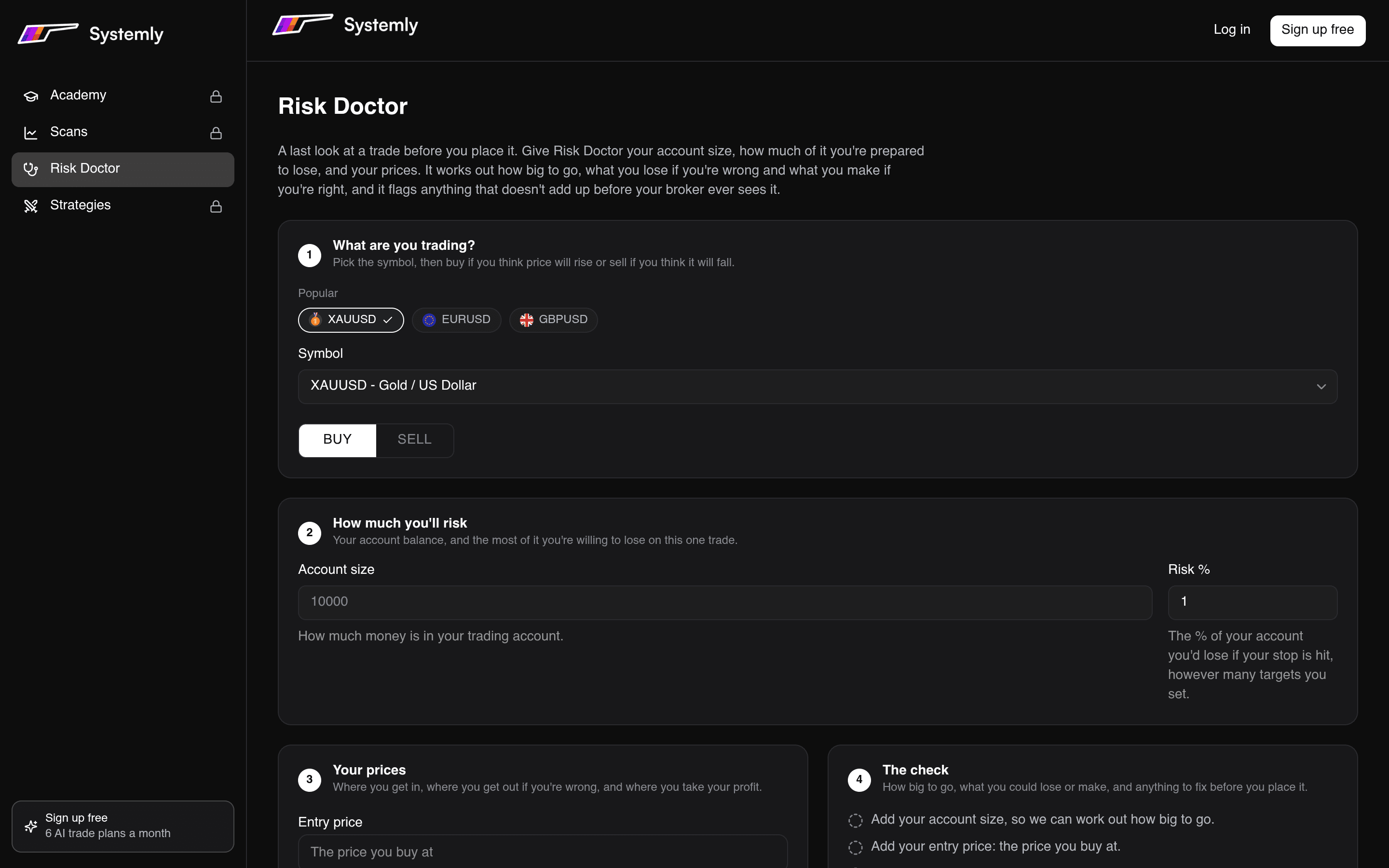
You pick an instrument and press scan. In under a minute you get a plan, or you are told there is nothing worth trading right now. Most moments do not pass the first check, so the app does not invent a setup to fill the silence.
The table below sets the Telegram message beside the fields of a Systemly-style plan. The right-hand column is an illustration of the fields only. It is not a real scan, not a live price and not a result.
- Direction: The Telegram signal: Sell; Systemly-style plan (illustration of fields, not a real trade): Buy, sell, or "nothing worth trading right now"
- Entry: The Telegram signal: A $4 zone, 2502 to 2506; Systemly-style plan (illustration of fields, not a real trade): One entry price
- Stop: The Telegram signal: 2508, no reason given; Systemly-style plan (illustration of fields, not a real trade): A stop price, plus the reason it marks the idea as wrong
- Targets: The Telegram signal: 2500 and 2498; Systemly-style plan (illustration of fields, not a real trade): Laddered targets, taking money off in steps
- Position size: The Telegram signal: Not given; Systemly-style plan (illustration of fields, not a real trade): Lots calculated from the balance and risk % you enter
- What would make it fail: The Telegram signal: Not given; Systemly-style plan (illustration of fields, not a real trade): Written out in plain English
- After the trade: The Telegram signal: Whatever the channel posts; Systemly-style plan (illustration of fields, not a real trade): Which level price reached, when, and how far it went against the trade first
Two rows matter most. The size row is personal: lots come from the balance and risk percentage you enter, so a £500 account and a £5,000 account see different numbers. The stop row is checked by code, not just written by a model. Once the AI has drafted the plan, code widens any stop that is too tight, shifts one sitting where stops are commonly hunted, and works the size out again from scratch. The short version: "The AI reads the chart. The code owns the trade."
What happens after the signal is sent?
This is where the difference is widest.
On many channels, the record is whatever gets posted afterwards. One r/FakeGuru user described it this way: "Everyone there posted their wins after the fact… Never before it happened. Always after." (r/FakeGuru). Even DailyForex, which runs its own free Telegram channel, warns its readers about "fake account screenshots".
Systemly follows each plan after it is sent. For each plan it logs the level price reached, the time it got there, and the furthest price moved against the trade before that. The losing plans go into that record alongside the winners. You can see what real plans look like in the public feed of community scans. The full plan needs a free login.
We do not publish a headline percentage from that record, and that is deliberate. A percentage without the stop and target distances behind it tells you almost nothing, as the zone table above shows. Our guide on why "80% win rate" signals mean less than you think works through the arithmetic.
Who pays for the free channel?
The typical funnel, as described by JP Trading Capital's guide to free Telegram signals, is a free channel, then a VIP tier at $50 to $300 a month, or free VIP access if you trade through a partner broker. The same source explains why that matters: "Per-lot commissions reward volume, which is why these channels fire 10 to 20 signals a day, suggest oversized lots, and love martingale-style 'recovery' entries."
Read "enter slowly, layer" again with that sentence in mind. Three orders instead of one is three times the volume. Nothing in this signal proves the channel behind it was paid that way. The business model simply rewards exactly this kind of instruction.
Telegram gold signals vs a complete trade plan
- What it is: Free Telegram channel: A chat channel posting short signal messages; Telegram VIP tier: A paid or broker-linked channel with more signals; Systemly: A trade-planning app with a built-in academy
- Cost to start: Free Telegram channel: Free; Telegram VIP tier: $50 to $300 a month, or free via a partner broker; Systemly: There is a free plan; paid plans add alerts, more plans and broker execution
- Entry: Free Telegram channel: Usually a zone; Telegram VIP tier: Usually a zone; Systemly: One price, or no trade
- Stop: Free Telegram channel: A price, rarely a reason; Telegram VIP tier: A price, sometimes a reason; Systemly: A price and the reason, checked by code
- Position size for your balance: Free Telegram channel: Rarely; Telegram VIP tier: Rarely; Systemly: Calculated from your balance and risk %
- Record of outcomes: Free Telegram channel: Posted by the channel; Telegram VIP tier: Posted by the channel; Systemly: Every plan tracked against real price, losses included
- Number of calls: Free Telegram channel: Often 10 to 20 a day; Telegram VIP tier: Often 10 to 20 a day; Systemly: Fewer, and often none, because most moments do not pass the checks
- A human trader to follow and chat with: Free Telegram channel: Yes; Telegram VIP tier: Yes; Systemly: No, plans come from AI checked by code
The last two rows are where a channel gives you more. If you want constant action and a person to talk to, a channel supplies both. That leads to the honest part.
Where a Telegram gold channel is the better choice
A Telegram channel can be the better tool for an experienced trader who already sizes every trade, already knows where they would put a stop, and wants a quick second opinion from someone they have followed for months. For that person the missing fields do not matter, because they fill them in themselves.
A channel also wins on company. Some traders value the chat, the running commentary and the feeling of trading alongside other people. Systemly does not offer a person to follow. If that is what you want, a channel gives you something an app does not.
And a free channel costs nothing to watch. Reading signals on a demo account, without placing real money, is a reasonable way to learn how other people frame gold trades. The risk starts when a beginner copies them with real money and no size.
A checklist for any gold signal: screenshot this
Before you act on any gold signal, from anyone, check it against these eight questions.
- Is the entry one price, or a zone? If it is a zone, where exactly will you get in?
- How far is the stop from your actual fill, in dollars of gold price movement?
- What is the reason for the stop, and could you explain it to a friend?
- What lot size does 1% of your account allow at that distance?
- Does that size round down to the 0.01-lot minimum, or would you have to round up?
- If you layer, what is the total loss if every order fills and the stop is hit?
- What would make the idea wrong before price reaches the stop?
- Who pays the channel, and do they earn more when you trade more?
If you cannot answer the first seven yourself, you are not ready to act on the signal. That is not a judgement on you. It is simply the work the signal left undone.
How we compared
We took one real gold signal posted by a beginner on Reddit and broke it down field by field, then set it against the fields a Systemly plan contains. Competitor facts come from the named sources and were checked on 24 September 2026. The gold arithmetic assumes 100 ounces per standard lot and £1 = $1.34; your broker's contract and today's exchange rate may differ. Prices for signal services change often, so check the provider's own page before paying.
FAQ
Are gold signals on Telegram legit?
Some are run honestly and many are not checkable. The main problem is structural rather than personal. Most channels give an entry zone, a stop and targets but no position size or reasoning, and they keep their own record. Many are funded by broker commissions per lot traded, which rewards volume. Treat any channel's results as unverified unless calls are posted before the move with timestamps.
What does "enter slowly, layer" mean in a gold signal?
It means splitting a position into several orders across the entry zone rather than entering once. On a sell signal, the higher orders only fill if price rises towards the stop, so the full position is only reached when the trade is going against you. Three 0.01-lot orders across a $4 zone can lose three times as much as one order at the middle.
How do I calculate lot size for gold on a £500 account?
Assume 1 standard lot is 100 ounces and check your broker's contract. At £1 = $1.34, £500 is about $670, so 1% risk is $6.70. With a $4.00 stop, one full lot loses $400. $6.70 ÷ $400 = 0.01675 lots. Round down to the 0.01 minimum, which risks $4.00, about 0.6% of the account.
Why do gold signals give an entry zone instead of one price?
A zone is flexible for the person posting it. For the follower it means the risk and reward are undefined until you are filled. On the signal in this article, filling at 2502 needed a 75% hit rate to break even at the first target, while filling at 2506 needed only 25%.
Are free Telegram forex signals really free?
Free channels usually earn money another way. A common funnel is a free channel, then a VIP tier at $50 to $300 a month, or free VIP access if you trade through a partner broker. Introducing-broker rebates are paid per lot traded, so the channel can earn from your trading whether you win or lose.
See a complete plan for yourself
Before you copy the next gold signal, look at what a full plan contains. You can browse real community scans or try Systemly's free plan on gold and compare the fields against the last message your channel sent. For how other providers stack up, see our comparison of forex signal providers.
Sources
- r/Forexstrategy, the gold signal quoted in this article: https://www.reddit.com/r/Forexstrategy/comments/1f0hhzf/
- VasilyTrader, common tactics of gold signal channels: https://www.vasilytrader.com/post/how-scam-gold-signals-channels-on-telegram-fake-trading-results-xauusd-groups
- r/trading212, on entry prices that did not execute: https://www.reddit.com/r/trading212/comments/1j726ss/
- r/FakeGuru, on wins posted after the fact: https://www.reddit.com/r/FakeGuru/comments/1ulo1ks/
- r/Trading, on oversized trades: https://www.reddit.com/r/Trading/comments/1rluknj/_/o8uubda/
- DailyForex, free Telegram channel and warning on fake screenshots: https://www.dailyforex.com/forex-brokers/best-forex-brokers/top-signals-telegram
- JP Trading Capital, the free-to-VIP funnel and per-lot commissions: https://www.jptradingcapital.com/blog/en/free-forex-signals-telegram
- Systemly Risk Doctor: https://app.systemly.ai/tools/risk-doctor
- Systemly community scans: https://app.systemly.ai/scans
Trading forex and CFDs carries a high risk of losing money, and most retail accounts do. Systemly is an educational and trade-planning tool. It does not provide financial advice or personal recommendations, and it is not authorised by the FCA to do so. Past outcomes do not predict future results.